



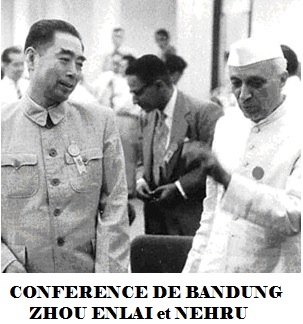
En ce 18 avril 2023, 68 ans après, que reste-t-il des grands principes de la conférence de Bandung ?
Les principes en ont-ils été vraiment appliqués par leurs concepteurs et leurs successeurs ?
Cherchez l’erreur…
Communiqué final de la conférence Afro-Asiatique de Bandoeng
24 avril 1955
Une Conférence des Nations Afro-Asiatiques convoquée par les gouvernements de Birmanie, de Ceylan, de l’Inde, d’Indonésie et du Pakistan s’est réunie à Bandoeng du 18 au 24 avril 1955. Outre les pays promoteurs, les Etats suivants ont participé à la Conférence :
Afghanistan, Cambodge, République populaire de Chine, Egypte, Ethiopie, Côte-de-l’Or, Iran, Irak, Japon, Jordanie, Laos, Liban, Liberia, Libye, Népal, Philippines, Arabie saoudite, Soudan, Syrie, Siam, Turquie, République populaire du Vietnam (Vietminh), Etat du Vietnam et Yémen. La Conférence afro-asiatique a étudié le rôle de l’Asie et de l’Afrique et a examiné les moyens grâce auxquels les peuples des pays représentés peuvent réaliser la coopération économique, culturelle et politique la plus étroite.
A) Coopération économique
1. La Conférence afro-asiatique reconnaît la nécessité urgente d’encourager le développement économique de la zone afro-asiatique. Les pays participants ont exprimé le désir général d’une coopération économique sur la base des intérêts mutuels et du respect de la souveraineté nationale.
Les propositions concernant la coopération économique entre les pays participants n’excluent pas le caractère désirable ou la nécessité d’une coopération avec les pays en dehors de la zone afro-asiatique, y compris les investissements de capitaux étrangers. Il a été reconnu que l’assistance reçue par certains des pays participants dans le cadre d’accords internationaux ou bi-latéraux – assistance émanant d’Etats extérieurs à la zone afro-asiatique – a représenté une contribution appréciable à la réalisation des programmes de développement des bénéficiaires.
2. Les pays participants décident de s’accorder une assistance technique, dans toute la mesure du possible, sous forme :
D’experts, de projets pilotes, de matériel de démonstration, d’échanges de documentation, d’établissement d’instituts de recherche et de formation nationaux et – si possible – régionaux qui prodigueront leurs connaissances techniques et scientifiques en coopération avec les organismes internationaux existants.
3. La Conférence afro-asiatique recommande :
L’établissement sans retard d’un fonds des Nations Unies pour le développement économique. L’allocation par la Banque internationale de reconstruction et de développement d’une plus grande partie de ses ressources aux pays afro-asiatiques.
La fondation rapide d’une corporation internationale financière qui devrait inclure dans ses activités l’engagement de procéder à des investissements. D’encourager l’organisation de projets communs entre les pays afro-asiatiques, dans la mesure où cela correspondra à leurs intérêts communs.
4. La Conférence afro-asiatique reconnaît la nécessité vitale de stabiliser le commerce des marchandises dans la zone afro-asiatique. Le principe de l’élargissement du domaine du commerce et des paiements multilatéraux a été accepté. Cependant il est admis que certains pays devront recourir aux mesures commerciales bilatérales en raison de leurs conditions économiques.
5. La Conférence afro-asiatique préconise une action collective des pays participants pour stabiliser les prix internationaux et la demande des marchandises essentielles par le jeu de dispositions bilatérales et multilatérales. Dans la mesure où cela est possible et désirable, les pays participants devraient adopter une ligne de conduite unifiée à l’égard de ce problème à la Commission consultative permanente des Nations Unies pour le commerce international des marchandises ainsi que dans les autres organisations internationales.
6. La Conférence estime que les pays d’Asie et d’Afrique doivent varier leurs exportations en manufacturant leurs matières premières toutes les fois que la chose est économiquement réalisable. Des foires commerciales inter-régionales doivent être organisées et il faut encourager l’échange de délégations commerciales et de groupes d’hommes d’affaires, l’échange d’informations et d’échantillons. Des facilités doivent être accordées pour le transit aux pays n´ayant pas de débouchés sur la mer.
7. La Conférence attache une importance considérable à la navigation et s’inquiète du fait que les compagnies révisent fréquemment les tarifs, souvent au détriment des utilisateurs. Elle recommande l’étude de ce problème et une action collective pour amener les compagnies de navigation à adopter une attitude plus raisonnable.
8. La Conférence estime qu’il faut encourager l’établissement de banques nationales et régionales et de compagnies d’assurances.
9. La Conférence estime que l’échange d’informations dans le domaine du pétrole peut aboutir à l’élaboration d’une politique commune.
10. La Conférence souligne l’importance du développement de l’utilisation pacifique de l’énergie atomique. Elle se félicite de l’initiative des Puissances principalement intéressées qui ont offert de fournir des informations dans ce domaine. Elle souhaite un établissement rapide de l’Agence internationale de l’Energie atomique, avec une représentation convenable des pays asiatiques. Elle recommande que les gouvernements asiatiques et africains exploitent les facilités offertes par les Puissances préconisant le développement pacifique de l’énergie atomique.
11. La Conférence a décidé de désigner des officiers de liaison auprès des pays participants, pour l’échange d’informations dans les questions d’intérêt commun. Elle recommande une utilisation plus complète des organisations internationales qui existent actuellement. Elle souhaite que les pays qui ne sont pas membres de ces organisations le deviennent lorsqu’ils sont qualifiés.
12. La Conférence préconise des consultations sur le plan international pour favoriser dans la mesure du possible les intérêts économiques des pays participants, mais la formation d’un bloc régional n’est pas son objectif.
B) Coopération culturelle
1. La Conférence est persuadée que le développement de la coopération culturelle figure parmi les moyens les plus puissants d´entente entre les Nations. L’Asie et l’Afrique ont été le berceau de grandes religions et de grandes civilisations qui ont enrichi d’autres cultures et d’autres civilisations. Ainsi la culture asiatique et africaine est basée sur des fondements spirituels universels. Malheureusement, les contacts culturels entre les pays asiatiques et africains ont été interrompus au cours des siècles passés. Les peuples d’Asie et d’Afrique sont maintenant animés d’un désir sincère de renouveler leurs contacts culturels et d’en développer de nouveaux dans le cadre du monde moderne. Tous les gouvernements participants ont confirmé leur intention de travailler pour une coopération culturelle plus étroite. La Conférence a pris note du fait que l’existence du colonialisme en de nombreuses régions d’Asie et d’Afrique, quelle que soit sa forme, entrave la coopération culturelle ainsi que le développement des cultures nationales. Certaines Puissances coloniales ont dénié aux peuples coloniaux les droits fondamentaux dans le domaine de l’éducation et de la culture, ce qui entrave le développement de leur personnalité ainsi que les échanges culturels avec d’autres peuples asiatiques et africains. Cela est particulièrement vrai dans le cas de la Tunisie, de l’Algérie et du Maroc, où le droit fondamental des peuples d’étudier leur propre langue et leur propre culture n’est pas respecté. Des discriminations semblables ont été pratiquées dans certaines régions du continent africain contre d’autres peuples. La Conférence estime qu’une telle politique équivaut à un déni des droits fondamentaux de l’homme, retarde le progrès culturel dans cette région et entrave la coopération culturelle sur le plan international. La Conférence condamne ce déni des droits de l’homme dans le domaine de l’éducation et de la culture dans certains parties de l’Asie et de l’Afrique par cette forme et d’autres formes d’oppression culturelle. En particulier, la Conférence condamne le racisme en tant que moyen d’oppression culturelle.
3. Ce n’est pas en se plaçant à un point de vue d’exclusivité ou de rivalité avec d’autres Nations, d’autres civilisations et d’autres cultures, que la Conférence considère le développement de la coopération culturelle dans les pays africains et asiatiques. Fidèle à une tradition séculaire de tolérance et d’universalité, la Conférence estime que la coopération culturelle asiatique et africaine doit se développer dans le contexte plus large de la coopération mondiale. Les pays d’Asie et d’Afrique désirent développer les contacts culturels avec d’autres pays, pour enrichir leur propre culture et contribuer à la paix et à l’entente mondiale.
4. Il existe de nombreux pays en Asie et en Afrique qui n’ont pas encore pu développer leurs institutions techniques, scientifiques et culturelles. La Conférence souhaite que les pays asiatiques et africains mieux placés à ce point de vue accordent des facilités aux étudiants des pays moins favorisés. Ces facilités doivent aussi être accordées aux peuples asiatiques et africains en Afrique auxquels on refuse à présent les moyens d’accéder à une éducation d’un niveau plus élevé.
5. La Conférence estime que l’effort de coopération culturelle des pays asiatiques et africains doit avoir pour but l’acquisition de leurs connaissances mutuelles, des échanges culturels, et des échanges d’information.
6. La Conférence estime qu’à l’heure actuelle les meilleurs résultats dans le domaine de la coopération culturelle peuvent être obtenus par des accords bilatéraux et par des initiatives individuelles de chaque pays, toutes les fois que la chose est possible.
C) Droits de l’Homme et auto-détermination
1. La Conférence afro-asiatique déclare appuyer totalement les principes fondamentaux des droits de l’homme tels qu’ils sont définis dans la Charte des Nations Unies et prendre en considération la Déclaration universelle des Droits de l’Homme comme un but commun vers lequel doivent tendre tous les peuples et toutes les Nations.
La Conférence déclare appuyer totalement le principe du droit des peuples et des Nations à disposer d’eux mêmes tel qu’il est défini dans la Charte des Nations Unies et prendre en considération les résolutions des Nations Unies sur le droit des peuples et des Nations à disposer d’eux-mêmes, qui est la condition préalable à la jouissance totale de tous les droits fondamentaux de l’homme.
2. La Conférence afro-asiatique déplore la politique et les pratiques de ségrégation et de discrimination raciales qui forment la base du système politique et des rapports humains dans de vastes régions d’Afrique et dans d’autres parties du monde. Un tel comportement est non seulement une violation grossière des droits de l’homme mais encore une négation des valeurs essentielles de la civilisation et de la dignité de l’homme. La Conférence exprime sa profonde sympathie et son appui pour l’attitude courageuse prise par toutes les victimes de la ségrégation raciale, particulièrement par les peuples d’origine africaine, indienne et pakistanaise en Afrique du Sud ; approuve chaleureusement tous ceux qui soutiennent leur cause ; réaffirme la détermination des peuples asiatiques et africains d’extirper toute trace de racisme qui pourrait exister dans leurs propres pays, et s’engage à user de toute son influence morale pour mettre en garde ceux qui courraient le danger d’être victimes du même fléau dans leur lutte pour l’extirper.
3. Considérant la tension existant au Moyen-Orient, tension qui est causée par la situation en Palestine, et considérant le danger que cette tension constitue pour la paix mondiale, la Conférence afro-asiatique déclare appuyer les droits du peuple arabe de Palestine et demande l’application des résolutions des Nations Unies sur la Palestine et la réalisation d’une solution pacifique du problème palestinien.
D) Problèmes des peuples dépendants
1. Conformément à la position qu’elle a prise sur l’abolition du colonialisme, la Conférence afro-asiatique soutient l’interprétation indonésienne des passages des accords entre les Pays-Bas et l’Indonésie relatifs à l’Ouest d’Irian (Nouvelle-Guinée Occidentale). La Conférence afro-asiatique presse le gouvernement néerlandais de rouvrir aussitôt que possible les négociations pour accomplir ses obligations découlant des accords mentionnés ci-dessus, et elle exprime l’espoir le plus ardent de voir les Nations Unies aider les parties intéressées à trouver une solution pacifique du différend.
2. En ce qui concerne la situation instable en Afrique du Nord et le refus persistant d’accorder aux peuples d’Afrique du Nord leurs droits de disposer d’eux-mêmes, la Conférence afro-asiatique déclare appuyer les droits des peuples d’Algérie, du Maroc et de Tunisie à disposer d’eux-mêmes et à être indépendants, et elle presse le gouvernement français d’aboutir sans retard à une solution pacifique de cette question.
E) Mesures en faveur de la paix et de la coopération mondiales
1. La Conférence afro-asiatique, prenant note du fait que plusieurs Etats n’ont pas encore été admis aux Nations Unies ; considérant que pour une coopération efficace pour la paix mondiale les Nations Unies devraient être universelles, fait appel au Conseil de Sécurité pour qu’il appuie l’admission de tous les Etats qui ont les qualités requises par la Charte pour être membres des Nations Unies. Selon le point de vue de la Conférence afro-asiatique, les pays qui y participent (Cambodge, Ceylan, Japon, Jordanie, Laos, Népal, les Etats du Sud-Vietnam et la République populaire du Vietnam après leur unification), ont ces qualités. La Conférence considère que la représentation des pays de la région asiatique et africaine au Conseil de Sécurité est inadéquate, compte tenu d’une équitable distribution géographique. En ce qui concerne la répartition des sièges des membres non permanents, la Conférence est d’avis que les pays asiatiques et africains qui, selon les dispositions de l’accord conclu à Londres en 1946, sont écartés de la possibilité d’y être élus puissent apporter une contribution efficace au maintien de la paix et de la sécurité internationales.
2. La Conférence afro-asiatique ayant considéré comme dangereuse la situation de tension internationale et les risques devant lesquels la race humaine tout entière se trouve par suite du danger de l’explosion d’une guerre totale dans laquelle le pouvoir destructif de tous les types d’armement, y compris les armes nucléaires et thermonucléaires, serait employé, porte à l’attention de toutes les Nations les terribles conséquences qui en résulteraient si une telle guerre devait éclater.
La Conférence considère que le désarmement et l’interdiction de la production, de l’expérimentation et de l’utilisation des armes de guerre nucléaires et thermonucléaires sont des nécessités impératives pour sauver l’humanité et la civilisation de la peur et de la perspective d’une destruction totale. Elle considère que les Nations d’Asie et d’Afrique assemblées ici ont le devoir envers l’humanité et la civilisation de proclamer leur soutien pour le désarmement et pour l’interdiction de ces armes, et fait appel aux Nations principalement intéressées et à l’opinion mondiale pour réaliser une telle interdiction. La Conférence considère qu’un contrôle international effectif devrait être établi et maintenu pour mettre en vigueur une telle interdiction et que des efforts rapides et déterminés devraient être faits dans ce but. En attendant la prohibition de toute fabrication d’armes nucléaires et thermonucléaires, la Conférence fait appel à toutes les Puissances intéressées pour réaliser un accord afin de suspendre les expériences avec de telles armes. La Conférence déclare qu’un désarmement universel est une nécessité absolue pour le maintien de la paix et demande aux Nations Unies de poursuivre leurs efforts : elle fait appel à tous les intéressés pour réaliser la réglementation et la limitation, le contrôle et la réduction de toutes les forces armées, de tous les armements, y compris l’interdiction de la production, de l’expérimentation et de l’utilisation de toutes les armes de destruction massive, et établir un contrôle international effectif dans ce but.
3. La Conférence afro-asiatique appuie la position du Yémen dans l’affaire d’Aden et des parties méridionales du Yémen connues sous le nom de protectorat et presse les parties intéressées d’arriver à un règlement pacifique du différend.
F) Déclaration sur les problèmes des problèmes des peuples dépendants
La Conférence afro-asiatique a discuté les problèmes des peuples dépendants et du colonialisme et des maux résultant de la soumission des peuples à l’assujettissement de l’étranger, à leur domination et à leur exploitation par ce dernier. La Conférence est d’accord :
1) Pour déclarer que le colonialisme, dans toutes ses manifestations, est un mal auquel il doit être mis fin
rapidement ;
2) Pour déclarer que la question des peuples soumis à l’assujettissement à l’étranger, à sa domination et à son exploitation constitue une négation des droits fondamentaux de l’homme, est contraire à la Charte des Nations Unies et empêche de favoriser la paix et la coopération mondiales ;
3) Pour déclarer qu’elle appuie la cause de la liberté et de l’indépendance de ces peuples;
4) Et pour faire appel aux Puissances intéressées pour qu’elles accordent la liberté et l’indépendance à ces peuples.
G) Déclaration sur les mesures en faveurs de la paix et de la coopération mondiales
La Conférence afro-asiatique s’est penchée anxieusement sur la question de la paix mondiale et de la coopération. Elle a pris note avec une profonde inquiétude de l’état de tension internationale et du danger de guerre atomique mondiale. Le problème de la paix est le corollaire du problème de la sécurité internationale. A cet égard, tous les pays devraient coopérer, particulièrement par le truchement des Nations Unies, pour amener une réduction des armements et l’élimination des armes nucléaires sous un contrôle international efficace. C’est de cette manière que la paix internationale peut être assurée et l’énergie nucléaire utilisée exclusivement à des fins pacifiques. Cela contribuerait à répondre aux besoins particuliers de l’Afrique et de l’Asie, car elles ont un besoin urgent de progrès social et d’un meilleur niveau de vie, ainsi que d’une plus grande liberté. Liberté et paix sont interdépendantes. Le droit à disposer de soi doit être accordé à tous les peuples, et la liberté et l’indépendance doivent être accordées dans les délais les plus courts possibles à ceux qui sont encore soumis. En vérité, toutes les nations devraient avoir le droit de choisir librement leurs propres systèmes politique et économique et leur propre mode de vie, conformément aux principes et aux buts des Nations Unies. Libérées de la méfiance, de la crainte, faisant preuve de bonne volonté mutuelle, les Nations devraient pratiquer la tolérance, vivre en paix dans un esprit de bon voisinage et développer une coopération amicale sur la base des principes suivants :
Dix principes
1) Respect des droits humains fondamentaux en conformité avec les buts et les principes de la Charte des Nations Unies ;
2) Respect de la souveraineté et de l’intégrité territoriale de toutes les Nations ;
3) Reconnaissance de l’égalité de toutes les races et de l’égalité de toutes les Nations, petites et grandes ;
4) Non-intervention et non-ingérence dans les affaires intérieures des autres pays ;
5) Respect du droit de chaque Nation de se défendre individuellement ou collectivement conformément à la Charte des Nations Unies ;
6) a) Refus de recourir à des arrangements de défense collective destinés à servir les intérêts particuliers des grandes Puissances quelles qu’elles soient; b) Refus par une Puissance quelle qu’elle soit d’exercer une pression sur d’autres ;
7) Abstention d’actes ou de menaces d’agression ou de l’emploi de la force contre l’intégrité territoriale ou l’indépendance politique d’un pays ;
8) Règlement de tous les conflits internationaux par des moyens pacifiques, tels que négociation ou conciliation, arbitrage ou règlement devant des tribunaux, ainsi que d’autres moyens pacifiques que pourront choisir les pays intéressés, conformément à la Charte des Nations Unies ;
9) Encouragement des intérêts mutuels et coopération ;
10) Respect de la justice et des obligations internationales. La Conférence afro-asiatique proclame sa conviction qu’une coopération amicale, conforme à ces principes, contribuerait effectivement au maintien et à la consolidation de la paix et de la sécurité, cependant qu’une coopération dans les domaines économique, social et culturel, contribuerait à donner la prospérité et le bienêtre à tous. La Conférence afro-asiatique a recommandé que les pays promoteurs envisagent la prochaine réunion de la Conférence en consultation avec d’autres pays intéressés.
Final Communiqué of the Asian-African Conference
24 april 1955
The Asian-African Conference, convened upon the invitation of the Prime Ministers of Burma, Ceylon, India, Indonesia and Pakistan, met in Bandung from the 18th to the 24th April, 1955. In addition to the sponsoring countries the following 24 countries participated in the Conference:
1. Afghanistan13. Liberia
2. Cambodia 14. Libya
3. People’s Republic of China 15. Nepal
4. Egypt 16. Philippines
5. Ethiopia 17. Saudi Arabia
6. Gold Coast 18. Sudan
7. Iran 19. Syria
8. Iraq 20. Thailand
9. Japan 21. Turkey
10. Jordan 22. Democratic Republic of Viet-Nam
11. Laos 23. State of Viet-Nam
12. Lebanon 24. Yemen
The Asian-African Conference considered problems of common interest and concern to countries of Asia and Africa and discussed ways and means by which their people could achieve fuller economic, cultural and political co-operation.
A. Economic co-operation.
1. The Asian-African Conference recognised the urgency of promoting economic development in the AsianAfrican region. There was general desire for economic co-operation among the participating countries on the basis of mutual interest and respect for national sovereignty. The proposals with regard to economic cooperation within the participating countries do not preclude either the desirability or the need for cooperation with countries outside the region, including the investment of foreign capital. It was further recognised that the assistance being received by certain participating countries from outside the region, through international or under bilateral arrangements, had made a valuable contribution to the implementation of their development programmes.
2. The participating countries agreed to provide technical assistance to one another, to the maximum extent practicable, in the form of: experts, trainees, pilot projects and equipment for demonstration purposes; exchange of know-how and establishment of national, and where possible, regional training and research institutes for imparting technical knowledge and skills in co-operation with the existing international agencies.
3. The Asian-African Conference recommended: the early establishment of the Special United Nations Fund for Economic Development; the allocation by the International Bank for Reconstruction and Development of a greater part of its resources to Asian-African countries; the early establishment of the International Finance Corporation which should include in its activities the undertaking of equity investment; and encouragement to the promotion of joint ventures among Asian-African countries in so far as this will promote their common interest.
4. The Asian-African Conference recognised the vital need for stabilizing commodity trade in the region. The principle of enlarging the scope of multilateral trade and payments was accepted. However, it was recognised that some countries would have to take recourse to bilateral trade arrangements in view of their prevailing economic conditions.
5. The Asian-African Conference recommended that collective action be taken by participating countries for stabilizing the international prices of and demand for primary commodities through bilateral and multilateral arrangements and that as far as practicable and desirable they should adopt a unified approach on the subject in the United Nations Permanent Advisory Commission on International Commodity Trade and other international forums.
6. The Asian-African Conference further recommended that: Asian-African countries should diversify their export trade by processing their raw material, wherever economically feasible, before export; intra-regional trade fairs should be promoted and encouragement given to the exchange of trade delegations and groups of businessmen; exchange of information and of samples should be encouraged with a view to promoting intraregional trade; and normal facilities should be provided for transit trade of land-locked countries.
7. The Asian-African Conference attached considerable importance to Shipping and expressed concern that shipping lines reviewed from time to time their freight rates, often to the detriment of participating countries. It recommended a study of this problem, and collective action thereafter, to induce the shipping lines to adopt a more reasonable attitude. It was suggested that a study of railway freight of transit trade may be made.
8. The Asian-African Conference agreed that encouragement should be given to the establishment of national and regional banks and insurance companies.
9. The Asian-African Conference felt that exchange of information on matters relating to oil, such as remittance of profits and taxation, might eventually lead to the formulation of common policies.
10. The Asian-African Conference emphasized the particular significance of the development of nuclear energy for peaceful purposes, for the Asian-African countries. The Conference welcomed the initiative of the Powers principally concerned in offering to make available information regarding the use of atomic energy for peaceful purposes; urged the speedy establishment of the International Atomic Energy Agency which should provide for adequate representation of the Asian-African countries on the executive authority of the Agency; and recommended to the Asian and African Governments to take full advantage of the training and other facilities in the peaceful uses of atomic energy offered by the countries sponsoring such programmes.
11. The Asian-African Conference agreed to the appointment of Liaison Officers in participating countries, to be nominated by their respective national Governments, for the exchange of information and ideas on matters of mutual interest. It recommended that fuller use should be made of the existing international organisations, and participating countries who were not members of such international organisations, but were eligible, should secure membership.
12. The Asian-African Conference recommended that there should be prior consultation of participating countries in international forums with a view, as far as possible, to furthering their mutual economic interest. It is, however, not intended to form a regional bloc.
B. Cultural co-operation.
1. The Asian-African Conference was convinced that among the most powerful means of promoting understanding among nations is the development of cultural co-operation. Asia and Africa have been the cradle of great religions and civilisations which have enriched other cultures and civilisations while themselves being enriched in the process. Thus the cultures of Asia and Africa are based on spiritual and universal foundations. Unfortunately contacts among Asian and African countries were interrupted during the past centuries. The peoples of Asia and Africa are now animated by a keen and sincere desire to renew their old cultural contacts and develop new ones in the context of the modern world. All participating Governments at the Conference reiterated their determination to work for closer cultural co-operation.
2. The Asian-African Conference took note of the fact that the existence of colonialism in many parts of Asia and Africa, in whatever form it may be, not only prevents cultural co-operation but also suppresses the national cultures of the people. Some colonial powers have denied to their dependent peoples basic rights in the sphere of education and culture which hampers the development of their personality and also prevents cultural intercourse with other Asian and African peoples. This is particularly true in the case of Tunisia, Algeria and Morocco, where the basic right of the people to study their own language and culture has been suppressed. Similar discrimination has been practised against African and coloured people in some parts of the Continent of Africa. The Conference felt that these policies amount to a denial of the fundamental rights of man, impede cultural advancement in this region and also hamper cultural co-operation on the wider international plane. The Conference condemned such a denial of fundamental rights in the sphere of education and culture in some parts of Asia and Africa by this and other forms of cultural suppression. In particular, the Conference condemned racialism as a means of cultural suppression.
3. It was not from any sense of exclusiveness or rivalry with other groups of nations and other civilisations and cultures that the Conference viewed the development of cultural co-operation among Asian and African countries. True to the age-old tradition of tolerance and universality, the Conference believed that Asian and African cultural co-operation should be developed in the larger context of world co-operation. Side by side with the development of Asian-African cultural co-operation the countries of Asia and Africa desire to develop cultural contacts with others. This would enrich their own culture and would also help in the promotion of world peace and understanding.
4. There are many countries in Asia and Africa which have not yet been able to develop their educational, scientific and technical institutions. The Conference recommended that countries in Asia and Africa which are more fortunately placed in this respect should give facilities for the admission of students and trainees from such countries to their institutions. Such facilities should also be made available to the Asian and African people in Africa to whom opportunities for acquiring higher education are at present denied.
5. The Asian-African Conference felt that the promotion of cultural co-operation among countries of Asia and Africa should be directed towards:
(I) the acquisition of knowledge of each other’s country;
(II) mutual cultural exchange, and
(III) exchange of information.
6. The Asian-African Conference was of the opinion that at this stage the best results in cultural co-operation would be achieved by pursuing bilateral arrangements to implement its recommendations and by each country taking action on its own, wherever possible and feasible.
C. Human rights and self-determination.
1. The Asian-African Conference declared its full support of the fundamental principles of Human Rights as set forth in the Charter of the United Nations and took note of the Universal Declaration of Human Rights as a common standard of achievement for all peoples and all nations. The Conference declared its full support of the principle of self-determination of peoples and nations as set forth in the Charter of the United Nations and took note of the United Nations resolutions on the rights of peoples and nations to self-determination, which is a pre-requisite of the full enjoyment of all fundamental Human Rights.
2. The Asian-African Conference deplored the policies and practices of racial segregation and discrimination which form the basis of government and human relations in large regions of Africa and in other parts of the world. Such conduct is not only a gross violation of human rights, but also a denial of the dignity of man. The Conference extended its warm sympathy and support for the courageous stand taken by the victims of racial discrimination, especially by the peoples of African and Indian and Pakistani origin in South Africa; applauded all those who sustain their cause; re-affirmed the determination of Asian-African peoples to eradicate every trace of racialism that might exist in their own countries; and pledged to use its full moral influence to guard against the danger of falling victims to the same evil in their struggle to eradicate it.
D. Problems of dependent peoples.
1. The Asian-African Conference discussed the problems of dependent peoples and colonialism and the evils arising from the subjection of peoples to alien subjugation, domination and exploitation.
The Conference is agreed:
(a) in declaring that colonialism in all its manifestations is an evil which should speedily be brought to an end;
(b) in affirming that the subjection of peoples to alien subjugation, domination and exploitation constitutes a denial of fundamental human rights, is contrary to the Charter of the United Nations and is an impediment to the promotion of world peace and co-operation;
(c) in declaring its support of the cause of freedom and independence for all such peoples, and
(d) in calling upon the powers concerned to grant freedom and independence to such peoples.
2. In view of the unsettled situation in North Africa and of the persisting denial to the peoples of North Africa of their right to self-determination, the Asian-African Conference declared its support of the rights of the people of Algeria, Morocco and Tunisia to self-determination and independence and urged the French Government to bring about a peaceful settlement of the issue without delay.
E. Other problems.
1. In view of the existing tension in the Middle East, caused by the situation in Palestine and of the danger of that tension to world peace, the Asian-African Conference declared its support of the rights of the Arab people of Palestine and called for the implementation of the United Nations Resolutions on Palestine and the achievement of the peaceful settlement of the Palestine question.
2. The Asian-African Conference, in the context of its expressed attitude on the abolition of colonialism, supported the position of Indonesia in the case of West Irian based on the relevant agreements between Indonesia and the Netherlands.
The Asian-African Conference urged the Netherlands Government to reopen negotiations as soon as possible, to implement their obligations under the above-mentioned agreements and expressed the earnest hope that the United Nations would assist the parties concerned in finding a peaceful solution to the dispute.
3. The Asian-African Conference supported the position of Yemen in the case of Aden and the Southern parts of Yemen known as the Protectorates and urged the parties concerned to arrive at a peaceful settlement of the dispute.
F. Promotion of world peace and co-operation.
1. The Asian-African Conference, taking note of the fact that several States have still not been admitted to the United Nations, considered that for effective co-operation for world peace membership in the United Nations should be universal, called on the Security Council to support the admission of all those States which are qualified for membership in terms of the Charter. In the opinion of the Asian-African Conference, the following among participating countries, viz.: Cambodia, Ceylon, Japan, Jordan, Libya, Nepal, a unified Vietnam were so qualified. The Conference considered that the representation of the countries of the Asian-African region on the Security Council, in relation to the principle of equitable geographical distribution, was inadequate. It expressed the view that as regards the distribution of the non-permanent seats, the Asian-African countries which, under the arrangement arrived at in London in 1946, are precluded from being elected, should be enabled to serve on the Security Council, so that they might make a more effective contribution to the maintenance of international peace and security.
2. The Asian-African Conference having considered the dangerous situation of international tension existing and the risks confronting the whole human race from the outbreak of global war in which the destructive power of all types of armaments, including nuclear and thermo-nuclear weapons, would be employed, invited the attention of all nations to the terrible consequences that would follow if such a war were to break out. The Conference considered that disarmament and the prohibition of the production, experimentation and use of nuclear and thermo-nuclear weapons of war are imperative to save mankind and civilisation from the fear and prospect of wholesale destruction. It considered that the nations of Asia and Africa assembled here have a duty towards humanity and civilisation to proclaim their support for disarmament and for the prohibition of these weapons and to appeal to nations principally concerned and to world opinion, to bring about such disarmament and prohibition. The Conference considered that effective international control should be established and maintained to implement such disarmament and prohibition and that speedy and determined efforts should be made to this end. Pending the total prohibition of the manufacture of nuclear and thermo-nuclear weapons, this Conference appealed to all the powers concerned to reach agreement to suspend experiments with such weapons. The Conference declared that universal disarmament is an absolute necessity for the preservation of peace
and requested the United Nations to continue its efforts and appealed to all concerned speedily to bring about the regulation, limitation, control and reduction of all armed forces and armaments, including the prohibition of the production, experimentation and use of all weapons of mass destruction, and to establish effective international control to this end.
G. Declaration on the promotion of world peace and co-operation.
The Asian-African Conference gave anxious thought to the question of world peace and co-operation. It viewed with deep concern the present state of international tension with its danger of an atomic world war. The problem of peace is correlative with the problem of international security. In this connection, all States should co-operate, especially through the United Nations, in bringing about the reduction of armaments and the elimination of nuclear weapons under effective international control. In this way, international peace can be promoted and nuclear energy may be used exclusively for peaceful purposes. This would help answer the needs particularly of Asia and Africa, for what they urgently require are social progress and better standards of life in larger freedom. Freedom and peace are interdependent. The right of self-determination must be enjoyed by all peoples, and freedom and independence must be granted, with the least possible delay, to those who are still dependent peoples. Indeed, all nations should have the right freely to choose their own political and economic systems and their own way of life, in conformity with the purposes and principles of the Charter of the United Nations. Free from mistrust and fear, and with confidence and goodwill towards each other, nations should practise tolerance and live together in peace with one another as good neighbours and develop friendly co-operation on the basis of the following principles:
Ten principles
1. Respect for fundamental human rights and for the purposes and principles of the Charter of the United Nations.
2. Respect for the sovereignty and territorial integrity of all nations.
3. Recognition of the equality of all races and of the equality of all nations large and small.
4. Abstention from intervention or interference in the internal affairs of another country.
5. Respect for the right of each nation to defend itself singly or collectively, in conformity with the Charter
of the United Nations.
6. (a) Abstention from the use of arrangements of collective defence to serve the particular interests of any of the big powers.
(b) Abstention by any country from exerting pressures on other countries.
7. Refraining from acts or threats of aggression or the use of force against the territorial integrity or political independence of any country.
8. Settlement of all international disputes by peaceful means, such as negotiation, conciliation, arbitration or judicial settlement as well as other peaceful means of the parties’ own choice, in conformity with the Charter of the United Nations.
9. Promotion of mutual interests and co-operation.
10. Respect for justice and international obligations.
The Asian and African Conference declares its conviction that friendly co-operation in accordance with these principles would effectively contribute to the maintenance and promotion of international peace and security, while co-operation in the economic, social and cultural fields would help bring about the common prosperity and well-being of all. The Asian-African Conference recommended that the Five Sponsoring Countries consider the convening of the next meeting of the Conference, in consultation with the participating countries.
Bandung, 24 April, 1955.