


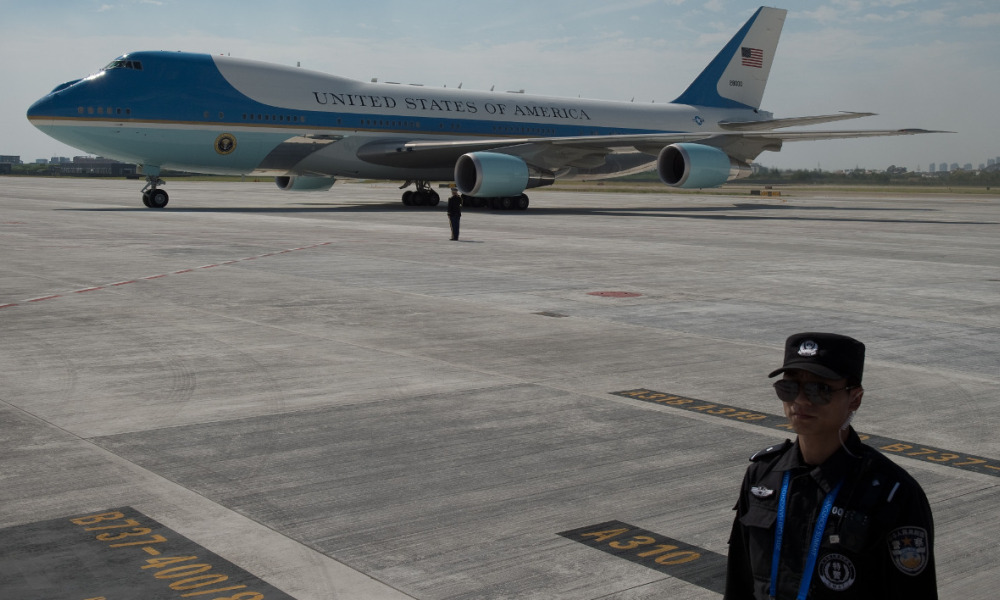
G20 : après l’incident de l’aéroport, Obama recadre les autorités chinoises
Le président américain a très mal perçu qu’un agent chinois rabroue une responsable de la Maison Blanche venue signifier qu’un journaliste pouvait approcher d’Air Force One.
Le président Barack Obama a souligné dimanche les différences entre la Chine et les Etats-Unis sur les droits de l’Homme et la liberté de la presse, en réponse à un incident survenu la veille avec les services de sécurité chinois.
« Il est important que la presse ait accès au travail que nous sommes en train de faire, qu’elle ait la possibilité de poser des questions », a déclaré le président après l’incident survenu sur le tarmac de l’aéroport de Hangzhouentre un agent chinois et la presse accréditée à la Maison Blanche.
« Nous ne laissons pas nos valeurs et nos idéaux derrière nous quand nous voyageons », a-t-il ajouté, assurant qu’il n’hésitait pas à parler des questions qui fâchent avec ses hôtes chinois.Obama se pose en défenseur des droits de l’Homme « Quand je soulève des questions comme celle des droits de l’Homme, il y a certaines tensions qui ne se produisent peut-être pas quand le président Xi rencontre d’autres dirigeants », a-t-il expliqué. Après l’atterrissage de l’avion présidentiel Air Force One, un agent chinois a empêché la presse américaine d’attendre sous l’une des ailes du Boeing 747 la descente de l’avion du président américain. Une responsable de la Maison Blanche est alors intervenue, signifiant à l’agent qu’il s’agissait d’un avion américain et du président des Etats-Unis.
Son interlocuteur chinois a aussitôt répliqué en hurlant en anglais: « Ici, c’est chez nous! C’est notre aéroport! ».Dans la foulée, l’agent a même tenté d’empêcher la conseillère à la Sécurité nationale Susan Rice de rejoindre le président, se précipitant dans sa direction quand elle a voulu passer sous le cordon qui délimitait l’espace réservé pour le passage de Barack Obama. Il a ensuite échangé des propos peu amènes avec la délégation américaine. Photo : Air Force One atterrit sur le tarmac à Hangzhou, le 3 septembre. – NICOLAS ASFOURI / AFP
Taiwanese, Hong Kongers and Uighurs Not Welcome Near G20
Published Fri, 09/02/2016 – 19:42

J. Michael Cole
2016/09/02
As authorities in Hangzhou, Zhejiang Province, prepare to host the G20 summit this weekend, China’s security apparatus has shifted into high gear, with as many as 100 people preemptively detained and many others ordered to skip town for a few days. Potential troublemakers from China’s peripheries are also being told to keep out.
Government authorities worldwide fear that various groups may attempt to use large gatherings of world leaders, such as the G20, to draw attention to their cause, whether they are environmental, religious, or political.
Particularly sensitive to any disturbance, the Chinese government is not taking any chances. Representatives from several European charities have been unable to obtain accreditation for the event, AFP reports. Dozens of Chinese have reportedly been detained, and several others have been compelled to travel outside the city during the Sept. 4-5 summit.
Local hotels have also tightened security and are refusing to entertain clients from Xinjiang, home of the ethnic — and persecuted — Uighur minority, which Beijing has accused of orchestrating several attacks across China in recent years.
At least one hotel, the Jinjiang, is even refusing to take in patrons from Hong Kong and Taiwan during the summit.
« We do not entertain clients from Xinjiang, Hong Kong or Taiwan, » a receptionist at the hotel told AFP. “After the G20 we can host them.”
Hong Kong’s Legislative Council election will be held on Sept. 4, with several localization candidates seeking to defy the pro-Beijing establishment in the increasingly restive territory. Meanwhile, relations with Taiwan have also become more tenuous following the election of the Democratic Progressive Party’s (DPP) Tsai Ing-wen (蔡英文) in the Jan. 16 elections. Beijing has reacted to her government’s refusal to adopt language on “one China” that it has been insisting upon by suspending some communication channels with Taiwan, where support for unification with China is at an all-time low. Several Taiwanese, particularly individuals associated with the DPP, have been denied entry visas into Hong Kong in recent months.