



PRESS RELEASE
(LA VERSION FRANÇAISE SUIT Ci-DESSOUS)
Sinicization of the United Nations Human Rights Council?
On June 15, 2026, the 62nd regular session of the United Nations Human Rights Council will open in Geneva. Another session of declarations and universal promises supposedly intended to defend human dignity. But behind the official speeches, an increasingly disturbing reality is emerging: China, with its colonial and dictatorial policies trampling fundamental human rights, is no l onger merely a member state of the Human Rights Council. It is progressively influencing its priorities, its silences and even its political language. In October 2022, even a simple proposal to open a debate on the violations committed against the Uyghurs in East Turkesta n was rejected at the Human Rights Council. This vote revealed the extent to which Beijing’s pressure, diplomatic alliances and influence networks now weigh on the very functioning of the Council.
The Chinese Communist Party no longer seeks merely to silence criticism. It now seeks to impose its own definition of human rights within the United Nations. In the vision of the Chinese Communist Party, human rights are no longer universal rights attached to human dignity. They become rights granted, limited or withdrawn according to the interests of the Party-State and the demands of political and social control.
Beijing has been implementing this logic in Tibet for decades: colonization, mass surveillance, indoctrination boarding schoo ls, destruction of religious and cultural heritage, population transfers, massive DNA collection and forced blood sampling imposed even on Tibetan children, family traceability across several generations, and the progressive erasure of Tibetan identity even through the words used to describe it.
But destruction also affects another fundamental pillar of Tibet: its environment. Long regarded as one of the world’s most p reserved territories, Tibet is now subjected to intensive exploitation of its natural resources: massive extraction of strategic minerals, particularly lithium, multiplication of mining activities using dangerous chemical products, and pollution of soil, rivers and air. And al l this in the name of the so-called “green transition”. The batteries and electric vehicles sold today in Europe as ecological symbols also rely on the exploitation of Tibetan resources, while the environmental consequences remain largely ignored. These products may be labelled “green” in Europe, but they are certainly not green for Tibet and neighboring peoples directly suffering the environmental consequences of this intensive exploitation: water pollution, soil contamination, destruction of ecosystems and the progressive degradation of one of the world’s largest freshwater reserves. Tibetan waters sustain the populations, agriculture and industries of a vast part of Asia. China and India alone represent nearly 2.84 billion inhabitants directly concerned by the great rivers originating from the Tibetan plateau. Polluting Tibet therefore means endangering far more than the Tibetan environment alone. In the interdependence of beings, peoples and all living things, fighting for Tibet and for the Tibetan people also means fighting for humanity itself
Whatever the Chinese Communist Party may fabricate, TIBET has never been part of China, and the Tibetan people have never been a Chinese ethnic minority. This is a historical fact.
But today, sinicization no longer stops at Tibet. It is now advancing into the heart of Western democracies through economic dependence, influence networks, political self-censorship and fear of offending Beijing. The word “Tibet” becomes sensitive. East Turkestan becomes diplomatically risky to name. Universities avoid certain subjects. Companies prefer silence over losing access to the Chinese market. Even some Western cultural institutions progressively adapt their vocabulary. The Musée Guimet affair in France is a revealing example.
Replacing the word “Tibet” with the expression “Himalayan World” is not a neutral scientific detail. It participates in a logic of symbolic erasure compatible with Beijing’s policy of cultural sinicization. Would it be scientific, and above all acceptable, to repla ce France with the “Alpine World”? Certainly not. Then why should it become acceptable for Tibet? While Western diplomats speak of “balanced dialogue,” Beijing advances methodically. Entire peoples progressively disappear from international language. Human rights become negotiable according to economic interests. At a time when 68,500 French companies went bankrupt in 2025, while European industry weakens and strategic dependence on China openly worries economists and media alike, European leaders, including Emmanuel Macron, neverth eless continue encouraging the expansion of Chinese interests in France and in Europe.
Even major European media outlets now publicly acknowledge the scale of the problem. Between April 20 and May 2, 2026 , in its investigative series “How China Is Devouring Europe,” the newspaper Le Monde described how China has become an industrial, technological and strategic superpower capable of deeply weakening European industries. The very titles of the four episodes already reflect a reality that is becoming increasingly difficult to ignore: “In thirty years, the Chinese Eldorado has turned into a trap for European industry” (April 20, 2026), “China’s overwhelming power: from batteries to nuclear energy, from innovative medicines to food additives, from high- speed trains to AI” (April 29, 2026), “Journey into the factory of the world, where nothing can stop the Chinese industrials teamroller” (April 30, 2026), and “Why Europe is incapable of defending its industry against the ‘second Chinese shock’” (May 2, 2026).
A sinicized France? A reality that can no longer be entirely dismissed.
But behind this late awareness lies another reality: economic dependence also produces political dependence. And sometimes even dependence of language itself. This is precisely the drift increasingly denounced today by suffering peoples: when economic interests become the priority, fundamental rights themselves become negotiable.
As Lucie Aubrac reminded us: “To resist is to refuse the unacceptable.”
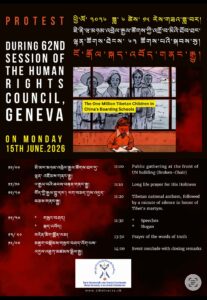
Announcement of non-violent resistance to the unacceptable: on June 15, 2026, the Tibetan Community in Switzerland and Liechtenstein will demonstrate in front of the United Nations in Geneva
It is precisely in this spirit that the Tibetan Community in Switzerland and Liechtenstein will demonstrate on June 15, 2026, in front of the United Nations in Geneva, on the occasion of the opening of the 62nd session of the Human Rights Council. The mobilization poster notably denounces the boarding school system imposed on more than one million Tibetan children, a true policy of sinicization aimed at cutting an entire generation off from its language, culture and identity.
We therefore invite everyone to gather on June 15, 2026, from 11:00 a.m. onwards in front of the United Nations in Geneva, at Place des Nations around the Broken Chair, an international symbol of civil resistance and human rights.
UNACCEPTABLE.
The France-Tibet Association publicly challenges the Human Rights Council in Geneva
We, the France-Tibet Association, publicly call on the United Nations Human Rights Council to stop turning a blind eye to the Chinese Communist Party’s strategy of influence within the United Nations itself.
We call for the violations committed in Tibet and East Turkestan to stop being marginalized, relativized or diplomatically bypassed in the name of economic interests and geopolitical balances.
We call for the opening of a genuine international debate on the policies of colonization, cultural repression, indoctrination boarding schools, environmental destruction, massive biometric surveillance and identity erasure imposed by Beijing in Tibet.
We call for recognition of the historical and political reality of Tibet: a country illegally and colonially occupied by China. Whatever the Chinese Communist Party may fabricate, Tibet has never been part of China, and the Tibetan people have never been a Chinese ethnic minority. Tibetan identity has every right to exist, just like the identity of the Uyghur people, the Han Chinese people or any other people in the world.
We call on the Human Rights Council to recover the political and moral courage it should embody in the face of a power now at tempting to impose its own definition of human rights within the United Nations itself.
For when a Human Rights Council becomes incapable even of opening a debate on certain violations, it is its own credibility t hat is at stake.
Diplomatic silence is not neutrality. Erasing words is not science. And inaction in the face of the unacceptable always ends up becoming a form of complicity.
European countries and peoples, wake up! Join the Tibetan non-violent resistance, resistance to the unacceptable.
Say NO to sinicization, for our values, for our democracies, for freedom and for our identities as peoples.
SINICIZATION IS UNACCEPTABLE!
Long live Tibet,
Long live the Tibetan People!
For the France-Tibet Association
Ugen-Tenzing NOUBPA
Vice-President
identibet@protonmail.com
https://tibet.fr/
NB: I am also officially and fully assuming the responsibility of addressing this press release to the diplomatic mission of the Chinese Communist Party to the United Nations Human Rights Council, as it is directly concerned by the issues raised in this text. My position is clear, firm, direct and fully assumed: the Tibetan, Uyghur and Mongolian peoples are, and will remain, peoples in their own right, and not merely Chinese ethnic minorities. But despite our profound disagreements, if the Chinese side is prepared for a respectful, sincere and non- violent dialogue on human rights and the rights of peoples, we are ready for such a dialogue, under the auspices of the United Nations Human Rights Council. For non-violence is not a weakness. On the contrary, it is an essential condition for any truly human, dignified and lasting dialogue between peoples.
VERSION FRANÇAISE
COMMUNIQUÉ DE PRESSE
Sinisation du Conseil des droits de l’homme de l’ONU ?
Le 15 juin 2026 s’ouvrira à Genève la 62e session ordinaire du Conseil des droits de l’homme de l’ONU. Une nouvelle session de déclarations et de promesses universelles censées défendre la dignité humaine. Mais derrière les discours officiels, une réal ité de plus en plus inquiétante s’impose : la Chine, avec sa politique coloniale et dictatoriale qui piétine les droits fondamentaux de l’homme, n’est plus seulement un État membre du Conseil des droits de l’homme. Elle influence progressivement ses priorités, ses silences et même son langage politique.
En octobre 2022, même une simple proposition visant à ouvrir un débat sur les violations commises contre les Ouïghours au Turkestan oriental a été rejetée au Conseil des droits de l’homme. Ce vote a révélé jusqu’où les pressions, alliances diplomatiques et réseaux d’influence de Pékin pèsent désormais sur le fonctionnement même du Conseil.
Car le Parti communiste chinois ne cherche plus seulement à faire taire les critiques. Il tente désormais d’imposer sa propre définition des droits humains au sein des Nations unies. Dans la vision du Parti communiste chinois, les droits humains ne sont plus des droits universels attachés à la dignité humaine. Ils deviennent des droits accordés, limités ou retirés selon les intérêts de l’État-Parti et les exigences du contrôle politique et social.
Cette logique, Pékin l’expérimente depuis des décennies au Tibet : colonisation, surveillance de masse, internats d’endoctrinement, destruction du patrimoine religieux et culturel, transfert de populations, collecte massive d’ADN et prélèvements sanguins forcés jusque sur des enfants tibétains, traçabilité familiale sur plusieurs générations, et effacement progressif de l’identité tibétaine jusque dans les mots utilisés pour la désigner.
Mais la destruction touche aussi un autre pilier fondamental du Tibet : son environnement. Longtemps considéré comme l’un des territoires les plus préservés au monde, le Tibet subit aujourd’hui une exploitation intensive de ses ressources naturelles : extraction massive de minerais stratégiques, notamment du lithium, multiplication des activités minières utilisant des produits chimiques dangereux, pollution des sols, des rivières et de l’air. Et cela au nom de la transition dite « verte ». Les batteries et voitures électriques vendues aujourd’hui en Europe comme symboles écologiques reposent aussi sur une exploitation du sous-sol tibétain dont les conséquences environnementales sont largement passées sous silence. Ces produits sont peut-être qualifiés de « verts » en Europe, mais ils ne le sont certainement pas pour le Tibet
et les peuples voisins qui subissent directement les conséquences environnementales de cette exploitation intensive : pollution des eaux, contamination des sols, destruction des écosystèmes et dégradation progressive de l’un des plus grands réservoirs d’eau douce de la planète.
Les eaux tibétaines nourrissent les populations, l’agriculture et les industries d’une immense partie de l’Asie. Rien que la Chine et l’Inde représentent à elles seules près de 2,84 milliards d’habitants directement concernés par les grands fleuves prenant leur source sur le plateau tibétain. Polluer durablement le Tibet, c’est donc mettre en danger bien plus que le seul environnement tibétain. Dans l’interdépendance des êtres, des peuples et du vivant, lutter pour le Tibet et pour le peuple tibétain, c’est aussi lutter pour l’humanité elle -même.
Quoi que fabule le Parti communiste chinois, le TIBET n’a jamais fait partie de la Chine, et le peuple tibétain n’a jamais ét é une minorité ethnique chinoise. C’est un fait historique.
Mais aujourd’hui, la sinisation ne s’arrête plus au Tibet. Elle avance désormais aussi au cœur des démocraties occidentales, par les dépendances économiques, les réseaux d’influence, l’autocensure politique et la peur de contrarier Pékin. Le mot « Tibet » devient sensible.
Le Turkestan oriental devient diplomatiquement risqué à nommer. Des universités évitent certains sujets. Des entreprises préfèrent le silence à la perte du marché chinois. Même certaines institutions culturelles occidentales adaptent progressivement leur vocabulaire. L’affaire du Musée Guimet en France en est un exemple révélateur. Remplacer le mot « Tibet » par l’expression « Monde himalayen » n’est pas un détail scientifique neutre. C’est participer à une logique d’effacement symbolique compatible avec la politique de sinisation culturelle menée par Pékin. Est-ce scientifique, et surtout acceptable, de remplacer la France par le « monde alpin » ? Certainement pas. Alors pourquoi ce la deviendrait-il acceptable pour le Tibet ? Pendant que les diplomates occidentaux parlent de « dialogue équilibré », Pékin avance méthodiquement. Des peuples disparaissent progressivement du langage international. Les droits humains deviennent négociables selon les intérêts économiques. Alors même que 68 500 entreprises françaises ont fait faillite en 2025, que l’industrie européenne s’affaiblit et que la dépendance stratégique à la Chine inquiète désormais ouvertement économistes et médias, les dirigeants européens, comme Emmanuel Macron, continuent pourtant d’encourager l’installation et l’expansion des intérêts chinois en France et en Europe.
Même certains grands médias européens reconnaissent désormais publiquement l’ampleur du problème. Entre le 20 avril et le 2 mai 2026, dans sa série d’enquêtes « Comment la Chine dévore l’Europe », le journal Le Monde décrit comment la Chine est devenue une superpuissance industrielle, technologique et stratégique capable de fragiliser profondément les industries européennes. Les titres mêmes des quatre épisodes traduisent déjà une réalité de plus en plus difficile à ignorer : « En trente ans, l’eldorado chinois s’est transformé en piège pour l’industrie européenne » (20 avril 2026), « La toute-puissance de la Chine : des batteries au nucléaire, des médicaments innovants aux additifs alimentaires, des TGV à l’IA » (29 avril 2026), « Voyage dans l’usine du monde, où rien n’arrête le rouleau compresseur industriel chinois » (30 avril 2026) et « Pourquoi l’Europe est incapable de défendre son industrie face au “second choc chinois” » (2 m ai 2026).
La France sinisée ? Une réalité désormais impossible à écarter totalement.
Mais derrière cette prise de conscience tardive demeure une autre réalité : la dépendance économique produit aussi une dépend ance politique.
Et parfois même une dépendance du langage lui-même. C’est précisément ce glissement que dénoncent aujourd’hui de plus en plus de peuples en souffrance : lorsque les intérêts économiques deviennent prioritaires, les droits fondamentaux deviennent eux aussi négociables.
Comme le rappelait Lucie Aubrac : « Résister, c’est refuser l’inacceptable. »
Annonce de la résistance non-violente à l’inacceptable : le 15 juin 2026, la Communauté Tibétaine en Suisse et au Liechtenstein manifeste devant l’ONU à Genève.
C’est précisément dans cet esprit que la Communauté Tibétaine en Suisse et au Liechtenstein manifestera ce 15 juin 2026 devant les Nations unies à Genève, à l’occasion de l’ouverture de la 62e session du Conseil des droits de l’homme. L’affiche de mobilisation dénonce notamment le système des pensionnats imposés à plus d’1 million d’enfants tibétains, véritable politique de sinisation visant à couper une génération entière de sa langue, de sa culture et de son identité.
Rendez-vous donc le 15 juin 2026 dès 11h00 devant les Nations unies à Genève, Place des Nations, autour de la Broken Chair, symbole international de la résistance civile et des droits humains.
INACCEPTABLE.
L’Association France-Tibet interpelle publiquement le Conseil des droits de l’homme à Genève
Nous, Association France-Tibet, demandons publiquement au Conseil des droits de l’homme de l’ONU de cesser de fermer les yeux sur la stratégie d’influence du Parti communiste chinois au sein même des Nations unies.
Nous demandons que les violations commises au Tibet et au Turkestan oriental cessent d’être marginalisées, relativisées ou diplomatiquement contournées au nom des intérêts économiques et des équilibres géopolitiques.
Nous demandons l’ouverture d’un véritable débat international sur les politiques de colonisation, de répression culturelle, d’internats d’endoctrinement, de destruction environnementale, de surveillance biométrique massive et d’effacement identitaire imposées par Pékin au Tibet.
Nous demandons que soit reconnue la réalité historique et politique du Tibet : un pays illégalement et occupé par la Chine colonialiste. Quoi que fabule le Parti communiste chinois, le Tibet n’a jamais fait partie de la Chine, et le peuple tibétain n’a jamais été une minorité ethnique chinoise. L’identité tibétaine a pleinement le droit d’exister, au même titre que celle du peuple ouïghour, du peuple han chinois ou de tout autre peuple du monde.
Nous demandons au Conseil des droits de l’homme de retrouver le courage politique et moral qui devrait être le sien face à une puissance qui tente désormais d’imposer sa propre définition des droits humains au sein même des Nations unies.
Car lorsqu’un Conseil des droits de l’homme devient incapable même d’ouvrir un débat sur certaines violations, c’est sa propre crédibilité qui est en jeu.
Le silence diplomatique n’est pas de la neutralité. L’effacement des mots n’est pas de la science. Et l’inaction face à l’inacceptable finit toujours par devenir une forme de complicité.
Pays et peuples européens, ressaisissez-vous ! Rejoignez la résistance non-violente tibétaine, résistance à l’inacceptable.
Dites NON à la sinisation, pour nos valeurs, pour nos démocraties, pour la liberté et pour nos identités de peuples.
LA SINISATION EST INACCEPTABLE !
Vive le Tibet,
Vive le Peuple Tibétain !
Pour l’Association France-Tibet
Ugen-Tenzing NOUBPA
Vice-Président
identibet@protonm