


Mon expression libre, franche et sans courbettes de mondanités culturelles
Une présence, des images, une visibilité. Le Bureau du Tibet présente cet événement comme un moment de diplomatie culturelle, une opportunité de visibilité sur la scène internationale. Soit. Mais de quoi parle-t-on réellement ? D’une inauguration, d’un patrimoine millénaire, du Liban, de l’actualité du Moyen-Orient.
Mais au vu de la nature de cet événement, une question s’impose : à quoi bon une présence tibétaine dans un événement centré sur les enjeux géopolitiques du Moyen-Orient, sans lien avec la question tibétaine ?
Et dans cette guerre, il faut le dire clairement : la Chine soutient l’Iran, qui soutient le Hezbollah, acteur central au Liban. Par conséquent, notre position devrait être sans ambiguïté : se tenir aux côtés des peuples et de leurs alliés, et non du régime des mollahs en Iran ni des organisations islamistes que le Parti communiste chinois soutient.
Et du Tibet ?
Rien. Pas un mot sur sa réalité politique, pas une mention de sa situation, pas la moindre évocation du peuple tibétain dans ce qu’il vit aujourd’hui. La présence est là, mais le sens est absent.
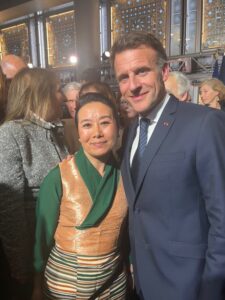
Ces images donnent à voir une intégration, une reconnaissance implicite. Mais elles relèvent avant tout d’une mondanité culturelle, parfaitement compatible avec les équilibres diplomatiques actuels. Et c’est là toute la limite.
Car la question tibétaine n’est pas une histoire de rencontre mondaine. C’est une question politique, de droit et de justice. L’essentiel est de faire passer des messages. Quel message a été échangé entre Emmanuel Macron et Rigzin Genkhang ? Le rapport n’en dit mot. Pas un mot non plus sur le droit d’exister du Tibet et du peuple tibétain, y compris en France, où ce droit est nié, entre effacement du mot « Tibet » et imposition d’une nationalité chinoise à tout·e ressortissant·e tibétain·e.
Et lorsque l’on replace ces images dans leur contexte politique, tout devient plus clair.
Je me souviens des mots d’Emmanuel Macron, rapportés par Le Monde avec Reuters, le 26 avril 2018 : « Si je rencontre demain le Dalaï-Lama à Paris (…) si je n’ai pas un mandat de la République chinoise (…) honnêtement ça ne sert à rien. »
Tout est dit. Un Président français qui attend un mandat d’une puissance étrangère ? Et le mandat du peuple français ?
Dès lors, que signifient réellement ces images ?
Elles montrent une présence tibétaine, oui. Mais elles ne traduisent en rien une reconnaissance politique du Tibet ni du peuple tibétain. Au contraire, elles s’inscrivent dans une ligne politique où la question tibétaine reste conditionnée, voire subordonnée, à la relation avec la Chine.
Une forme d’alignement que l’on retrouve ailleurs : dans la tolérance de l’effacement du mot « Tibet » dans certaines institutions culturelles, comme au Musée Guimet, dans des situations où tout ressortissant tibétain se voit imposer la nationalité chinoise en France, et dans une diplomatie qui privilégie l’équilibre avec Pékin au détriment de la vérité politique.
Quelle dignité, dans le pays des droits de l’homme ?
Je demande à la diplomatie et à la représentation tibétaine de rester attentives à ce que de telles images ne soient pas interprétées comme une validation de la ligne politique d’Emmanuel Macron, qui s’aligne de fait sur la position chinoise concernant le Tibet et le peuple tibétain.
Emmanuel Macron revendique une politique du « en même temps ». Mais sur la question Chine, Tibet, ce « en même temps » n’opère pas : la position suivie converge avec celle de Pékin.
Restons donc vigilants, et évitons de mettre la main dans un sac de scorpions au Moyen-Orient.
Vive le Tibet
Vive le peuple tibétain
གུས་བོད་པའི་གླེན་ཆུང་ནུབ་པ་ཨོ་རྒྱན་ནས།
Le P’tit Bêtain Ugen
Vice-Président de France-Tibet
Version anglaise
My free, frank expression without the courtesies of cultural mundanity
(Translation from French to English by my ex-wife, a trilingual professional translator)
https://www.facebook.com/share/186xWjzx9E/?mibextid=wwXIfr
A presence, images, visibility. The Office of Tibet presents this event as a moment of cultural diplomacy, an opportunity for visibility on the international stage. So be it. But what are we really talking about? An inauguration, a millennia-old heritage, Lebanon, and the current situation in the Middle East.
But given the nature of this event, a question arises: what is the point of a Tibetan presence at an event focused on the geopolitical issues of the Middle East, with no connection to the Tibetan question?
And in this war, it must be said clearly: China supports Iran, which supports Hezbollah, a central actor in Lebanon. Therefore, our position should be unambiguous: to stand with peoples and their allies, not with the regime of the mullahs in Iran nor with the Islamist organizations supported by the Chinese Communist Party.
And Tibet?
Nothing. Not a word about its political reality, not a mention of its situation, not the slightest reference to what the Tibetan people are going through today. The presence is there, but the meaning is absent.
These images suggest integration, an implicit form of recognition. But above all, they belong to a form of cultural mundanity, perfectly compatible with current diplomatic balances. And that is the limit.
Because the Tibetan question is not a matter of social encounters. It is a political issue, a matter of law and justice. What matters is to convey messages. What message was exchanged between Emmanuel Macron and Rigzin Genkhang? The report does not say. Not a word either about the right of Tibet and the Tibetan people to exist, including in France, where this right is denied, through the erasure of the word “Tibet” and the imposition of a Chinese nationality on every Tibetan national.
And when these images are placed back into their political context, everything becomes clearer.
I recall the words of Emmanuel Macron, reported by Le Monde with Reuters on April 26, 2018: “If I meet the Dalai Lama tomorrow in Paris (…) if I do not have a mandate from the People’s Republic of China (…) honestly, it serves no purpose.”
Everything is said. A French President waiting for a mandate from a foreign power? And what about the mandate of the French people?
So what do these images really mean?
They show a Tibetan presence, yes. But they in no way reflect any political recognition of Tibet or the Tibetan people. On the contrary, they fit within a political line in which the Tibetan question remains conditioned, even subordinated, to relations with China.
A form of alignment that can be seen elsewhere: in the tolerance of the erasure of the word “Tibet” in certain cultural institutions such as the Guimet Museum, in situations where every Tibetan national in France is administratively assigned Chinese nationality, and in a diplomacy that prioritizes balance with Beijing over political truth.
What dignity remains, in the country of human rights?
I call on Tibetan diplomacy and representation to remain attentive, so that such images are not interpreted as an endorsement of Emmanuel Macron’s political line, which effectively aligns with China’s position regarding Tibet and the Tibetan people.
Emmanuel Macron claims a policy of “both at the same time.” But on the question of China and Tibet, this “both at the same time” does not operate: in practice, the position taken converges with that of Beijing.
Let us therefore remain vigilant, and avoid putting our hand into a bag of scorpions in the Middle East.
Long live Tibet
Long live the Tibetan people
གུས་བོད་པའི་གླེན་ཆུང་ནུབ་པ་ཨོ་རྒྱན་ནས།
The Little Silly Tibetan Ugen
Vice-President of France-Tibet