Release Liu Xiaobo On Human Rights Day
December 9, 2015
Rep. Chris Smith
On the eve of Human Rights Day, we gather here because China is in a race to the bottom with North Korea for the title of world’s worst violators of human rights. The hope that an economically prosperous and « rising China » would embrace political reform and human rights has been completely destroyed. It is time for a new approach.
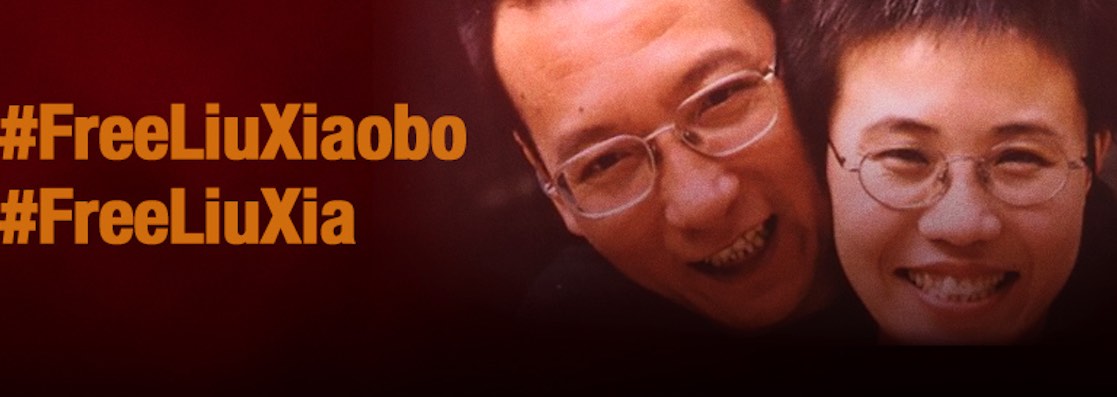
Nobel Peace Prize Laureate Liu Xiaobo remains in prison and his wife Liu Xia remains detained and isolated in conditions of arbitrary detention.
We are here today because private diplomatic efforts have not lead to Liu Xiaobo’s release. We are here to ask that President Obama, and other world leaders, renew efforts to, publically and privately, seek their release.
For the past five years, we have called on China to immediately and unconditionally release Liu Xiaobo and Liu Xia.
Today, we similarly demand that China end this absurdity and its unjust and lawless treatment of these noble citizens-release them and all others who remain detained in China for their political beliefs.
We will not forget Liu Xiaobo or his wife. The CECC remains committed to seeking their release from confinement and detention. We will not forget them next year, or the year thereafter-regardless of the circumstances-or how uncomfortable it makes the Chinese government.
I do not believe that President Obama or the Administration has done enough to secure Liu Xiaobo’s release. The President is certainly not as clear and tough on the issue of political prisoners as he is on cyber-security issues or environmental issues with China.
That the President, a fellow Nobel Laureate, has been reluctant to raise these cases in public-and link them to better U.S.-China relations-is certainly perceived as weakness by China’s leaders.
We cannot continue to engage in the fantasy that avoiding human rights will somehow bring about a change of heart in Beijing. It will not.
Until the release of Liu Xiaobo, and many others rights defenders, are a clear and consistent priority of U.S.-China relations, the Chinese government will continue to believe that it can act with impunity and without any consequences.
As the 2015 Annual Report of the Congressional-Executive Commission on China (CECC) shows, the government of President Xi Jinping has staged an extraordinary assault on the rule of law, human rights, ethnic minority groups, and civil society in recent years.
Under Xi’s leadership, the Chinese government has pushed through new laws and draft legislation that would legitimize political, religious, and ethnic repression, further curtail civil liberties, and expand censorship of the Internet. The CECC has a list of over 1,300 known political prisoners.
It is tempting to be pessimistic about China’s future and the future of U.S.-China relations. I am not pessimistic. Standing here today with these heroes-I am hopeful. Constant repression has not dimmed the desires of the Chinese people for freedom and reform.
But the U.S. cannot be morally neutral in this regard. We cannot be silent in the face of the Chinese government’s repression. We must show leadership and resolve because only the U.S. has the power and prestige to stand up to China’s intransigence.
The U.S. must not shy away from meeting with the Dalai Lama or other dissidents. We must use visa bans on Chinese officials who violate human rights. We must connect Internet and press freedoms as both economic and human rights priorities. And we must demand, repeatedly and clearly, that the unconditional release of political prisoners is in the interest of better U.S.-China relations.
I believe that someday China will be free. Someday, the people of China will be able to enjoy all of their God-given rights. And a nation of free Chinese men and women will honor and celebrate Liu Xiaobo as a hero. He will be honored along with all others like him who have sacrificed so much, and so long, for freedom.


 Action Chaise vide – Justine Souque, CC BY SA 2.0