


Pour votre information, suite :
LA VERSION ANGLAISE (l’originale) après la version française (traduite par mon ex-épouse, traductrice professionnelle)
THE ENGLISH VERSION (the original) follows the French version (translated by my ex-wife, a professional translator)
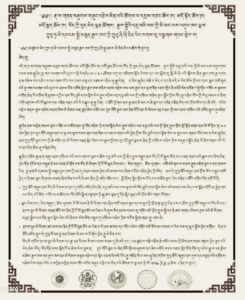
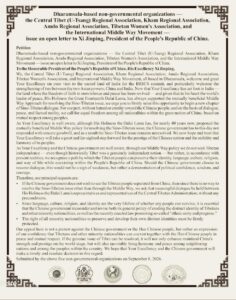
J’ai finalement reçu le texte intégral de cette déclaration… pétition ? lettre ouverte ? Le document lui-même semble hésiter sur sa propre nature ! Je l’ai reçu en tibétain et en anglais, voir photos, grâce à un ami tibétain toujours prompt et particulièrement attentif à l’actualité tibétaine. Un grand merci à lui !
Je ne vais pas répéter ici ce que j’ai déjà écrit hier sur cette initiative et ces cinq organisations. Mais la lecture du texte intégral soulève quelques questions supplémentaires.
D’abord, sur la forme, s’agit-il d’une lettre ouverte ou d’une pétition ? Le document est présenté comme une « lettre ouverte » adressée à Xi Jinping, mais porte le titre « Petition ». Il faudrait savoir ! Et s’il s’agit d’une pétition, où sont les signatures des pétitionnaires ?
Puis vient cette formule : « À l’honorable Président de la République populaire de Chine, Son Excellence Xi Jinping ». Formellement et protocolairement, « À Monsieur Xi Jinping, Président de la République populaire de Chine » suffisait amplement. Président de la République populaire de Chine, c’est sa fonction. Mais « honorable » ? Pour moi, certainement pas ! À force de déférence, on quitte le protocole pour tomber dans une forme de lèche-bottes mandarine.
Même dans son immense compassion, je n’ai jamais entendu Sa Sainteté le Dalaï-Lama éprouver le besoin de qualifier Xi Jinping d’« honorable ». Je me souviens d’ailleurs d’un entretien dans lequel Sa Sainteté expliquait avoir découvert, au contact du Parti communiste chinois, ce qu’était l’hypocrisie. Sa Sainteté sait tendre la main, appeler au dialogue et à la réconciliation, parler sans haine de ses adversaires et défendre inlassablement la non-violence. Mais la compassion n’est ni la naïveté ni la flatterie.
Le respect se gagne en restant soi-même, pas en singeant des courbettes à la chinoise. Prenons exemple sur Sa Sainteté le Dalaï-Lama qui, face aux dirigeants successifs du Parti communiste chinois, Mao Zedong, Deng Xiaoping, Li Peng, Jiang Zemin, Hu Jintao et Xi Jinping, a toujours su rester fidèle à une même ligne de conduite : une non-violence forte, lucide et déterminée. Constance de Sa Sainteté, impermanence des dirigeants chinois et de leurs politiques ! Tendre la main sans courber l’échine, dialoguer sans se renier, respecter l’autre sans s’effacer soi-même, voilà une leçon dont certains devraient peut-être s’inspirer.
Et que l’on ne compare surtout pas mes propos aux siens ! Ma réaction de P’tit Bêtain n’a ni la hauteur ni la portée de la parole de Sa Sainteté. Nous ne sommes tout simplement pas au même niveau.
Moi, je réagis avec mes mots, ceux d’un humble Tibétain bien terre à terre, né au Tibet et ayant grandi en France dès mon plus jeune âge, comme Tibétain et pupille de la Nation française. Ma manière de raisonner, de questionner, et même mon goût de la contradiction, portent forcément aussi l’empreinte de la France où j’ai grandi. Alors je parle comme je suis, citoyen suisse qui vote, tibétain par mes racines, français par une grande part de ma formation et de ma tournure d’esprit, P’tit Bêtain par autodérision, avec l’Ahimsa et la Voie du Milieu comme principes de résistance !
Merci à Orgyen Rinpoché (Gourou Rinpoché), à la Suisse, à la France, à Charles de Gaulle, au Mahatma Gandhi, à Nagarjuna (Gœnpo Loudroup), à Sa Sainteté le Dalaï-Lama, ainsi qu’à tous mes Maîtres français et tibétains, et à mes ami-es d’ici et d’ailleurs. Chacun, à sa manière, a contribué à faire du P’tit Bêtain ce qu’il est aujourd’hui !
Sur le fond, une contradiction me frappe particulièrement. Les cinq organisations reconnaissent elles-mêmes que « historiquement le Tibet a été une nation véritablement indépendante », mais parlent ensuite de la « grande nation chinoise » et rangent les Tibétains parmi les « minorités nationales ».
Il faudrait, là encore, savoir !
Si le Tibet a historiquement été une nation véritablement indépendante, comment son peuple devient-il soudain une « minorité nationale » au sein de cette prétendue « grande nation chinoise » ? Ce n’est pas une simple question de vocabulaire. Les mots ont un sens et, en politique, ils ont des conséquences.
Une autre phrase m’interpelle : « Notre appel ici n’est pas une protestation contre le gouvernement chinois… »
Mais de quel « gouvernement chinois » parle-t-on réellement ? Soyons réalistes, en Chine, c’est un État-parti qui gouverne. Le Parti communiste chinois domine le système politique. La Constitution existe, certes, mais dans la réalité du pouvoir, le Parti occupe une place déterminante. Parler simplement de « gouvernement chinois » finit donc par masquer l’essentiel, le rôle central du PCC dans la politique menée au Tibet.
Il faut nommer clairement les choses. Ce que je combats n’est pas le peuple chinois, mais la politique de cet État-parti au Tibet. Le PCC ne mène pas au Tibet une politique improvisée ou accidentelle. La sinisation, l’assimilation, l’effacement du Tibet, de sa langue et de son identité répondent, à mes yeux, à une politique organisée, délibérée et poursuivie dans la durée.
Et c’est précisément là que la démarche de ces cinq organisations me paraît politiquement naïve. Croire qu’un véritable dialogue sino-tibétain puisse aujourd’hui être rouvert avec la Chine de Xi Jinping à coups de formules déférentes relève, pour moi, davantage du fantasme politique que du réalisme. C’est ignorer, ou refuser de regarder en face, la réalité de la politique de l’État-parti chinois au Tibet et la logique géopolitique dans laquelle elle s’inscrit.
Qualifier Xi Jinping d’« honorable », lui souhaiter la bienvenue et prendre soin de préciser que l’on ne proteste pas contre le « gouvernement chinois » créeraient-ils réellement les conditions d’un dialogue ? J’en doute profondément.
Je souhaite le dialogue et je soutiens la Voie médiane. Mais vouloir dialoguer ne dispense jamais de regarder lucidement celui avec lequel on veut dialoguer.
On peut tendre la main au peuple chinois, souhaiter le dialogue, refuser toute haine et toute violence, tout en s’opposant clairement, pacifiquement et sans ambiguïté à la politique du Parti communiste chinois au Tibet. C’est précisément cela, pour moi, la résistance non violente. La non-violence ne consiste pas à ne plus nommer celui dont on combat la politique.
La Voie médiane, c’est parler avec Pékin sans cesser d’être nous-mêmes, dialoguer sans s’effacer, négocier sans se renier, chercher un compromis sans reprendre le vocabulaire politique que Pékin veut nous imposer.
La Voie médiane exige le dialogue, certes, mais elle exige aussi du réalisme. Sinon, la politique cède la place au fantasme.
La compassion n’est pas la flatterie.
La non-violence n’est pas la non-résistance.
La Voie médiane n’est pas l’effacement.
Voilà simplement les réflexions du P’tit Bêtain à la lecture du texte intégral.
བོད་དང་བོད་མི་མང་རྒྱལ་ལོ།
Vive le Tibet, Vive le Peuple Tibétain !
གུས་བོད་པའི་གླེན་ཆུང་ནུབ་པ་ཨོ་རྒྱན་བསྟན་འཛིན་ནས།
Le P’tit Bêtain Ugen-Tenzing Noubpa
Vice-Président de France-Tibet
https://tibet.fr/actualites/pour-moi-jamais-de-bienvenue-a-xi-jinping-et-a-sa-politique-colonialiste-et-imperialiste-non-a-la-sinisation-du-tibet-non-a-la-sinisation-politique-de-leurope-et-de-lonu/
For your information, a follow-up:
I have finally received the full text of this declaration… petition? open letter? The document itself seems unsure of its own nature! I received it in Tibetan and English, see photos, thanks to a Tibetan friend who is always quick to respond and particularly attentive to Tibetan current affairs. Many thanks to him!
I am not going to repeat here what I already wrote yesterday about this initiative and these five organisations. But reading the full text raises a few additional questions.
First, as a matter of form, is this an open letter or a petition? The document is presented as an “open letter” addressed to Xi Jinping, yet it bears the title “Petition”. Which is it? And if it is a petition, where are the signatures of the petitioners?
Then comes this wording: “To the Honorable President of the People’s Republic of China, His Excellency Xi Jinping.” Formally and in terms of protocol, “To Mr Xi Jinping, President of the People’s Republic of China” would have been more than sufficient. President of the People’s Republic of China is his official position. But “honorable”? Certainly not for me! With so much deference, we leave protocol behind and slip into a kind of Mandarin bootlicking.
Even in his immense compassion, I have never heard His Holiness the Dalai Lama feel the need to describe Xi Jinping as “honorable”. I also remember an interview in which His Holiness explained that, through his dealings with the Chinese Communist Party, he had discovered what hypocrisy was. His Holiness knows how to extend a hand, call for dialogue and reconciliation, speak of his adversaries without hatred, and tirelessly defend non-violence. But compassion is neither naïveté nor flattery.
Respect is earned by remaining true to oneself, not by mimicking Chinese-style bowing and scraping. Let us take our example from His Holiness the Dalai Lama who, faced with successive leaders of the Chinese Communist Party, Mao Zedong, Deng Xiaoping, Li Peng, Jiang Zemin, Hu Jintao and Xi Jinping, has always remained faithful to the same course: strong, clear-sighted and determined non-violence. The constancy of His Holiness, the impermanence of Chinese leaders and their policies! Extending a hand without bowing one’s head, engaging in dialogue without betraying oneself, respecting the other without erasing oneself, that is a lesson some might perhaps learn from.
And above all, let no one compare my words with his! The reaction of the Little Silly Tibetan has neither the stature nor the significance of the words of His Holiness. We are simply not on the same level.
I react in my own words, those of a humble, down-to-earth Tibetan, born in Tibet and raised in France from a very young age, as a Tibetan and a ward of the French Nation. The way I reason, question things, and even my taste for contradiction, inevitably bear the imprint of the France in which I grew up. So I speak as I am: a Swiss citizen who votes, Tibetan by my roots, French through a large part of my education and way of thinking, the Little Silly Tibetan through self-mockery, with Ahimsa and the Middle Way as principles of resistance!
My thanks to Orgyen Rinpoche (Guru Rinpoche), to Switzerland, to France, to Charles de Gaulle, to Mahatma Gandhi, to Nagarjuna (Gœnpo Loudroup), to His Holiness the Dalai Lama, as well as to all my French and Tibetan Masters, and to my friends here and elsewhere. Each, in their own way, has helped make the Little Silly Tibetan what he is today!
As for the substance, one contradiction strikes me in particular. The five organisations themselves acknowledge that “historically Tibet was a genuinely independent nation”, yet they then speak of the “great nation of China” and classify Tibetans among the “minority nationalities”.
Again, which is it?
If Tibet was historically a genuinely independent nation, how does its people suddenly become a “minority nationality” within this supposed “great nation of China”? This is not simply a matter of vocabulary. Words have meaning and, in politics, they have consequences.
Another sentence catches my attention: “Our appeal here is not a protest against the Chinese government…”
But what “Chinese government” are we really talking about? Let us be realistic: China is governed as a party-state. The Chinese Communist Party dominates the political system. The Constitution exists, of course, but in the reality of power, the Party occupies a decisive position. Simply speaking of the “Chinese government” therefore ends up obscuring the essential point: the central role of the CCP in the policies pursued in Tibet.
Things must be called by their proper names. What I oppose is not the Chinese people, but the policies of this party-state in Tibet. The CCP’s policies in Tibet are neither improvised nor accidental. In my view, the Sinicisation, assimilation and erasure of Tibet, its language and its identity are part of an organised, deliberate policy pursued over time.
And this is precisely where the approach of these five organisations strikes me as politically naïve. To believe that genuine Sino-Tibetan dialogue can be reopened today with Xi Jinping’s China through deferential formulas seems to me more like political fantasy than realism. It means ignoring, or refusing to face, the reality of the policies pursued by the Chinese party-state in Tibet and the geopolitical logic within which they operate.
Would calling Xi Jinping “honorable”, welcoming him and carefully stating that one is not protesting against the “Chinese government” really create the conditions for dialogue? I seriously doubt it.
I want dialogue and I support the Middle Way Approach. But wanting dialogue never absolves us from looking clearly at the person with whom we wish to engage.
We can extend a hand to the Chinese people, seek dialogue, reject all hatred and violence, while clearly, peacefully and unambiguously opposing the policies of the Chinese Communist Party in Tibet. That, precisely, is what nonviolent resistance means to me. Non-violence does not mean refusing to name those whose policies we oppose.
The Middle Way Approach means speaking with Beijing without ceasing to be ourselves, engaging in dialogue without erasing ourselves, negotiating without betraying ourselves, seeking compromise without adopting the political vocabulary Beijing seeks to impose upon us.
The Middle Way Approach requires dialogue, certainly, but it also requires realism. Otherwise, politics gives way to fantasy.
Compassion is not flattery.
Non-violence is not non-resistance.
The Middle Way Approach is not self-erasure.
These are simply the reflections of the Little Silly Tibetan after reading the full text.
བོད་དང་བོད་མི་མང་རྒྱལ་ལོ།
Long live Tibet, Long live the Tibetan People!
གུས་བོད་པའི་གླེན་ཆུང་ནུབ་པ་ཨོ་རྒྱན་བསྟན་འཛིན་ནས།
The Little Silly Tibetan Ugen-Tenzing Noubpa
Vice-President of France-Tibet
https://tibet.fr/actualites/pour-moi-jamais-de-bienvenue-a-xi-jinping-et-a-sa-politique-colonialiste-et-imperialiste-non-a-la-sinisation-du-tibet-non-a-la-sinisation-politique-de-leurope-et-de-lonu/