An Iron Fist in a Green Glove
Emptying pastoral Tibet with China’s national parks
EXECUTIVE SUMMARY
Nomadic pastoralists have flourished sustainably on the Tibetan Plateau for hundreds of generations. Glimpse into the world of Tibetan nomads, and we soon uncover a sophisticated way of life carefully tuned to the local environment, grounded in a deep connection to place, and guided by rich local knowledge and collective decision-making. Indeed, it is only the unique partnership between nomads and their animals that has made life on the cold, arid Roof of the World possible. The nomads, like all those living close to the land, understand their lives depend on the health of their pastures, their water sources and the complex web of life that surrounds them, and so take no more than can be replenished to sustain them the next year. To the nomads, the landscape is sacred, inhabited by many spirits and deities, and fiercely protected. In this way, they ensure the Tibetan Plateau remains a healthy, biodiverse and productive ecosystem. And with the Tibetan Plateau the fountainhead of Asia’s great rivers, this is something upon which many millions of people beyond Tibet’s borders depend. Today, as the world, including China, grapples with the intertwined challenges of climate damage, food and water security, inequality and biodiversity loss, the knowledge, wisdom and practices of Tibetan nomads are more applicable now than ever. However, this is not how China sees it. For two decades, the Chinese government has been removing Tibetan nomads from their grasslands. This forced displacement is now set to accelerate under a new system of national parks, including four large parks stretching across the Tibetan Plateau. While China seldom states this directly, a closer look at its elaborate plans for biodiversity protection, poverty alleviation, land restoration, securing water supply and climate change mitigation reveals that almost all involve the exclusion of Tibet’s nomads from their pastures. These plans, if left unchallenged, will mean the almost total demise of nomadic pastoralism in Tibet. An end to a way of life that had enabled Tibetans to live successfully and sustainably for millennia. Years of testimony from displaced nomads coupled with a growing body of scientific research shows that these policies can be devastating for communities, harmful to the environment and counterproductive to all of China’s stated aims. Further, that Tibetans themselves can offer vital solutions to the challenges that China is purporting to solve. Traditional nomadic grazing can play an essential role in reversing grassland degradation, which has been brought about by decades of policy mistakes under China, including constraining the mobility that has been crucial to sustainable pasture management in Tibet. With downstream water security – China’s number one priority – dependent on healthy upper catchments, Tibetans, who have been determined through the ages to protect these sacred water sources, must again be seen as part of the solution, not a problem. When it comes to efforts to sequester more carbon in the Tibetan landscape to offset China’s burgeoning greenhouse emissions, China will likely gain nothing by removing nomads and their herds from the grasslands. On the contrary, maintaining soil carbon long-term depends on careful management and is aided by the presence, not absence, of the traditional custodians. Similarly, ungrazed and depopulated grassland in Tibet loses biodiversity as longer grasses and the hardier species begin to dominate. Also, when it comes to iconic wildlife such as snow leopards and wild antelope, Tibetan patrols were, until recently, the only safeguard against poachers. Lastly, the experiences of displaced nomadic communities make a mockery of China’s claim that forced resettlement is necessary to alleviate poverty. In their own words, Tibetan nomads, when out on the range, consider themselves wealthy. It is only when stripped of their traditional livelihoods and forced to the urban fringe and left to survive on handouts; they become impoverished. A better way forward is possible: A path of cooperative, inclusive solutions that protect biodiversity, ensure secure land tenure, promote food and water security for all, and uphold Tibetans’ right to choose their future. Many joint initiatives of Tibetan, Chinese and international NGOs in recent decades have demonstrated what is possible – how it is not a matter of choosing between environmental protection and human livelihoods, but how both can, and indeed must go together. While on the surface, the announcement of new national parks spanning Tibet may seem like welcome news, Australia Tibet Council strongly encourages all interested parties including environmental NGOs, development agencies, government and parliamentarians to consider the consequences of China’s current plans for Tibetans. The international community should not welcome these national parks until China genuinely embraces collaborative management approaches that value the role of Tibet’s traditional custodians and uphold their rights, thereby promising a secure and dignified future for Tibetans while protecting the Tibetan Plateau for all humanity. With the fate of Tibet’s remaining nomads now hanging in the balance, the task ahead is clear. It is vital that Tibetan voices are heard. Also, the global community of conservationists, development practitioners, and human rights defenders works collectively to challenge China’s policies towards Tibetan nomads while advocating strongly for a cooperative and inclusive path forward.INTRODUCTION
© John Birchak
The news out of Tibet is all good, at least on the surface. New national parks will open in 2020, guaranteeing the Chinese government will protect threatened wildlife, including Tibet’s iconic species such as snow leopards, wild yaks and Tibetan antelope, and also rare medicinal plants.
After decades of exploitation and intensive mineral extraction, big new national parks stretching across the Tibetan Plateau sound like a good move. So why are the Tibetans not rejoicing, after decades of Chinese control over Tibet causing pollution and destruction of their environment? Surely a shift, from plunder to protection is just what the Tibetans, a predominantly Buddhist population with a long tradition of respecting nature, would want?
It is not as simple as the story China, an authoritarian regime, tells the world about its new enthusiasm for wildlife and empty, pristine wilderness landscapes populated only by wild animals.
China’s national parks plan requires depopulating Tibet. Nearly all human presence, from miners to pastoralists, is declared a threat and has to be removed. Only scientists and park staffers will remain.
This report challenges China’s unacknowledged assumption that nearly all nomads (known in Tibetan as drogpa) must leave. China seldom says this directly. Instead, China makes elaborate plans for biodiversity conservation that happen to exclude almost all human presence from defined core and buffer zones. China announces poverty alleviation as a top priority, and only in the fine print that in many areas, especially in officially labelled “contiguous destitute areas” of Tibet, the solution to poverty is to remove the people to towns and cities. Similarly, China’s policies on land degradation, water supply and climate change adaptation all happen, in the fine print, to exclude nomads from their pastures.
This report plunges into that fine print, into the menu of policies China has announced, which leaves nowhere for nomads to maintain their traditional, skilful, sustainable stewardship of a land so vast it is one-quarter of modern-day China.
Having assessed China’s policies and their devastating consequences for sustainable Tibetan landscape and biodiversity stewardship, this report then suggests constructive alternatives. In the past, Tibetan domestic and wild herds mingled, sacred areas were respected. What worked before China asserted mastery over the unfamiliar rangelands of Tibet can work in the future. This report itemises the many joint initiatives of Tibetan, Chinese and international NGOs in recent decades to protect biodiversity and human livelihoods together, and proposes cooperative, inclusive solutions.
For these reasons, we ask conservationists and development agencies worldwide to pause before congratulating China on what may seem to be all good: new national parks. We ask them to hear Tibetan voices, evaluate the negative impacts independently and encourage China to recognise Tibetan nomads as part of the solution, especially in degraded areas needing labour-intensive rehabilitation.
Nationalising vast Tibetan landscapes and repurposing them as mass domestic tourism destinations will cause many consequences. The new national parks mean the end of the traditional Tibetan mode of production, an end to Tibetan land tenure security and collective food security; replacing productive and sustainable landscape management with idle lives on urban fringes dependent on rations handed out by the state, which expects gratitude in return.
Sadly, the story will be all too familiar to indigenous and local communities in many parts of the world. From Indian tribes illegally evicted from the forest to make way for tiger reserves, to Indigenous Australians who have survived over two centuries of colonisation. Only belatedly are governments coming to recognise that the best way to protect forests, grasslands and other ecosystems is to uphold people’s right to remain on their ancestral homelands and to support traditional land management practices.
At the heart of this Tibetan story are two universal themes – the right of all peoples to determine their future and the value of traditional knowledge and practices when confronting the significant challenges of today.
This is not a romantic, outsider’s view of traditional Tibetan life, nor does it deny Tibetans’ right to development and modernity. We aim to propose an inclusive solution. A solution based on a new respect for the experience and wisdom of Tibet’s nomads, and their freedom to maintain and enhance their traditional livelihoods, an essential part of a sustainable future for Tibet, China and the wider region.
It is, therefore, a story of hope and solutions. However, also one of great urgency.
PART 1: BACKGROUND Nomads, their grasslands and sacred spaces
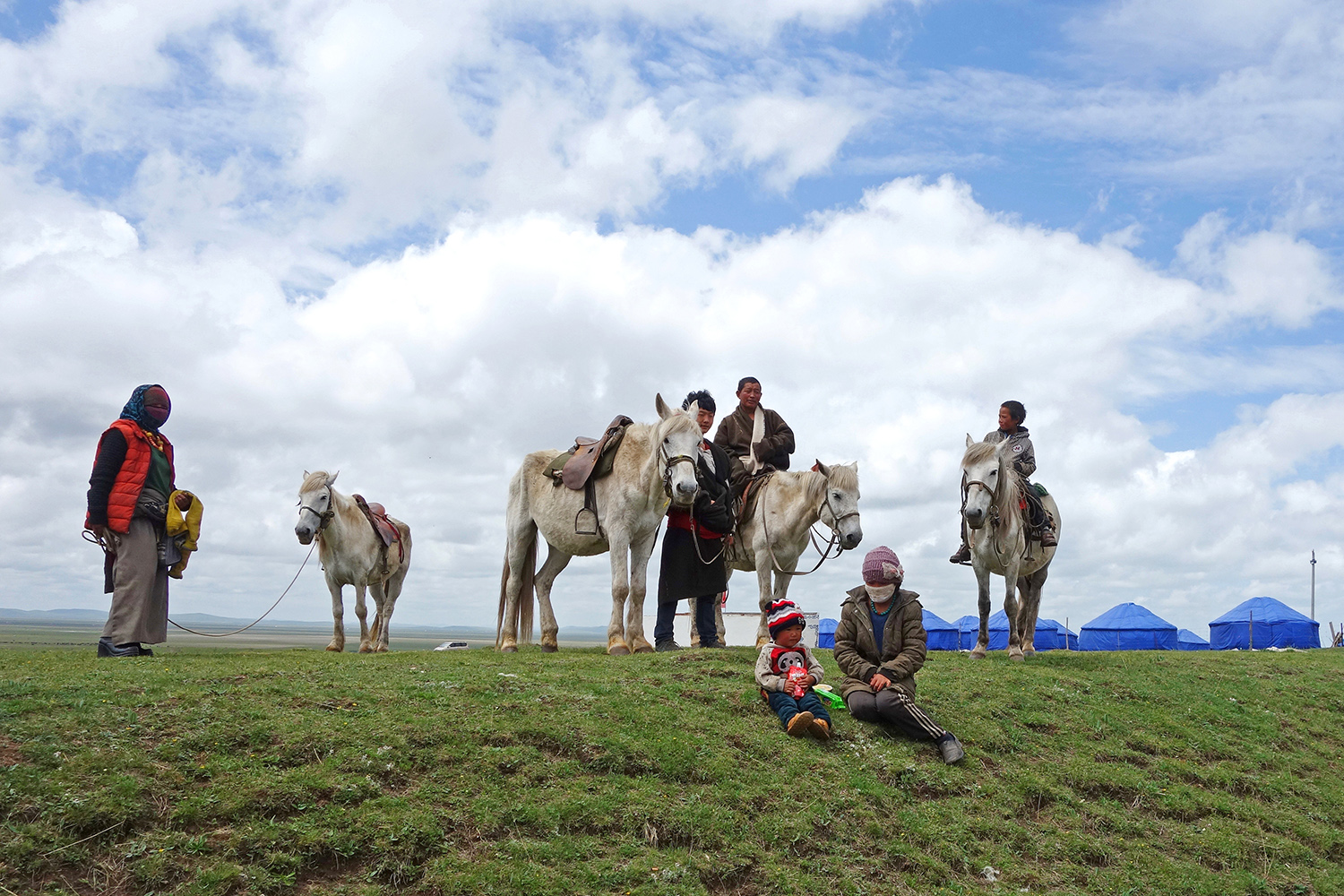
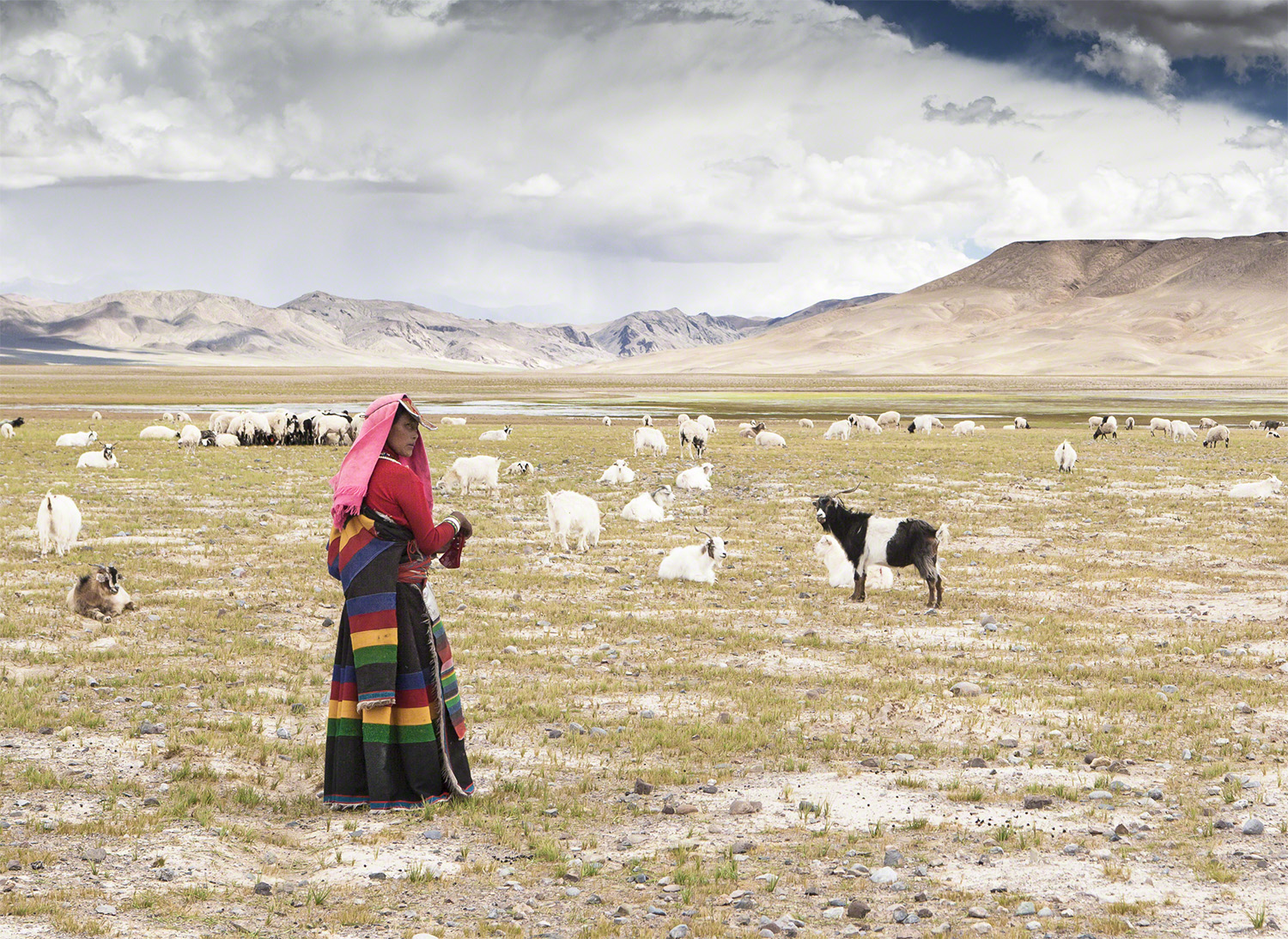
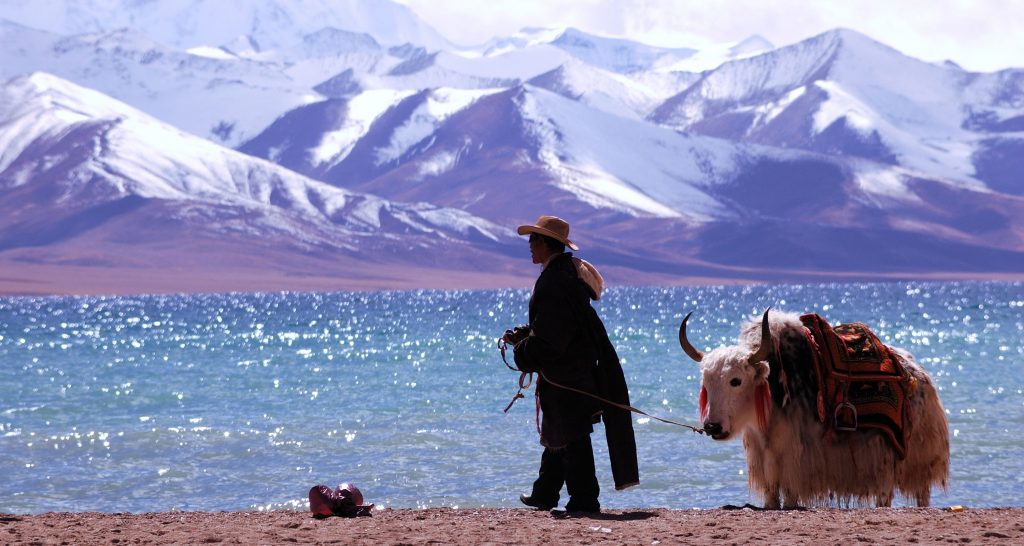
The Tibetan Plateau is unique, a vast island in the sky, so frigid it takes special people, and a unique partnership with animals, to make it habitable. Nomadic pastoralism – the herding of livestock from one pasture to another – is what has made human life on the cold, arid Tibetan Plateau possible, productive and sustainable.
Nomads move their herd on before the land becomes overgrazed or when the seasons dictate it is time to move, allowing the grass to regrow. Some nomads move cyclically between fixed summer (highland) and winter (lowland) pastures.
Tibetan pastoralists usually know each animal in the herd. When herds are mingled to graze and then again separated, the animals know the unique call of each pastoral family. Tibetans consider themselves wealthy if they have a herd on the hoof, and are reluctant to sell for slaughter, as herd size is collateral, insurance, dowry, working capital and the best strategy for recovery if disaster such as blizzards and gales hit unpredictably.
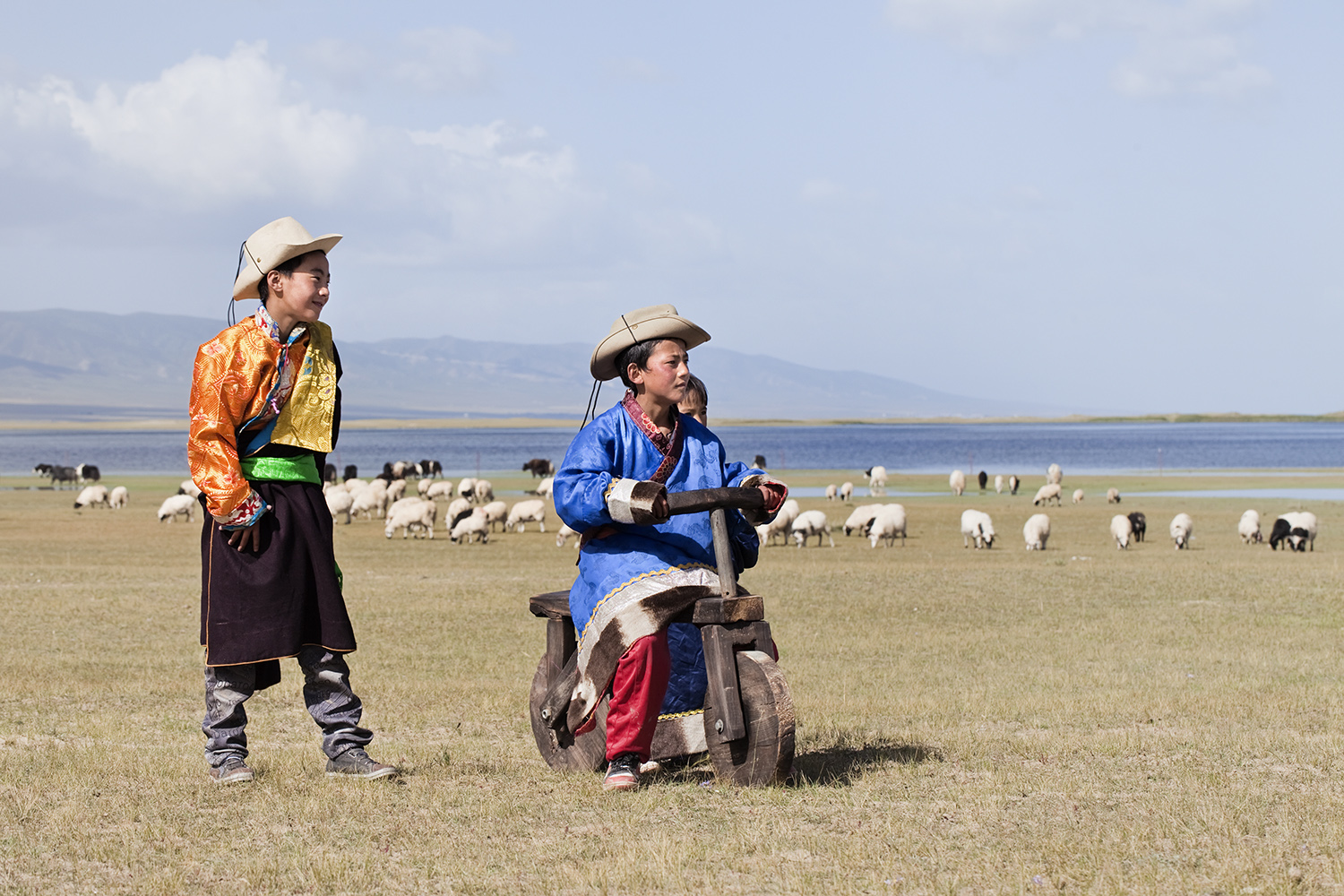
Over centuries, herders developed sophisticated practices carefully adapted to local conditions: determining the best migration times and routes and the optimal size and mix of animals (yaks, goats and sheep). Decisions on when and where to move are made collectively by groups of families.
Traditionally, nomads’ herds provided for almost all their needs: the yak’s coarse wool was used to make tents and ropes, its bones to make tools, its milk drunk or preserved as butter and yoghurt, its dung used as fuel for cooking and its meat their primary source of protein. Sheepskins kept people warm. It was a life of few needs, with plenty of leisure for family life and daily spiritual practices honouring the local gods of the waters, trees, lakes and mountains.
In turn, the animals ensured the grasslands remained a productive, biodiverse and healthy ecosystem – fertilising it with their dung and eating or trampling away weeds. The nomads and their herds co-existed and shared the pasture with wild animals, including migratory herds of Tibetan antelope, gazelle and wild yaks. Their mobility, preparedness, the collaboration between families and rich local knowledge enabled nomads to be resilient in the unpredictable and capricious nature of their environment.
Until relatively recently, the story of life on the Roof of the World was of symbiosis between Tibetans and their herds. This is what scientists today term a coupled human and natural system.
China’s solutions to the problems China created

When China took command of the Tibetan pastoral landscapes in the late 1950s, intensified production was the goal, collectivisation of herds and herders the method to achieve it. On the communes, the former traditional pasture owners had to meet production targets set by communist cadres with the power to withhold survival rations if people did not meet their quota. The emphasis was on building herd size as quickly as possible, and on accelerating slaughter rates.
The nomads worried that forcing nature to submit to human will offend the water spirits and local gods, resulting in disaster, but were powerless. The great famine of 1960 through 1962 then took place. The communes failed but did not collapse until the late 1970s, two decades in which sedentarised nomads had to build fences to pen animals, without wire or posts, by digging the living turf and piling sod on sod high enough to deter animals from seeking pasture.
Starting in the 1980s, China went from the extreme of communisation to that of making each family separately responsible for a specified allocation of land, usually suitable only as winter pasture, which had to be fenced with wire and posts, financed by mandatory bank loans which put nomadic families in debt.
The outcome of this “household responsibility system” was loss of mobility, the flexibility to move with the herd according to grass growth and seasonal change in a highly uncertain climate. Fencing led to disputes between neighbours and between clans, where before there had been ambiguity as to where one pasture ended and another began.
In the words of a senior nomad, Puntar:
“At that time, the livestock had to graze in a small area, following the same grazing orbit every day. As a result, the vegetation was consumed more quickly, resulting in inadequate forage. Plus, we could not move to the winter pasture as it did not belong to us. We had to stay at the settlement for three seasons (winter, spring and summer). The livestock was getting weaker and weaker, and there was little fat on meat…. We lost many livestock.”As we explore in the next section, this now well-established pattern of top-down, coercively applied ‘solutions’ to problems of China’s own making continues apace.
PART 2: DISMANTLING CHINA’S JUSTIFICATIONS FOR DISPLACING NOMADS Land degradation: Causes and cures
© Lobsang Khokze
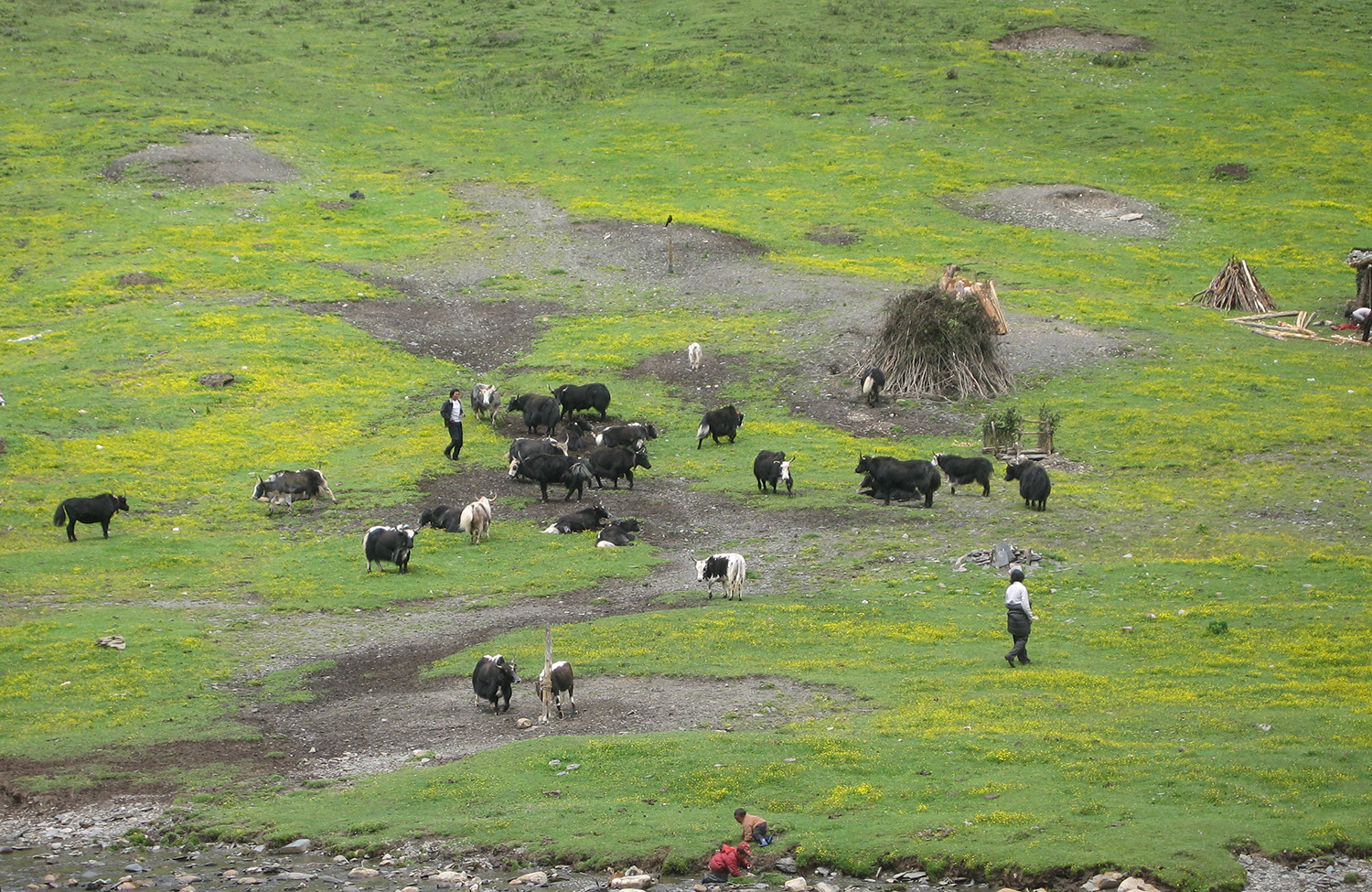
Covering more than half of the colossal Tibetan Plateau, Tibet’s grasslands are one of the world’s most important grassland ecosystems.
The compulsory fenced enclosure of animals had inevitable results. Overgrazing by demobilised herds killed the hardy grasses accustomed to both winter cold and moderate grazing. They keep most of their biomass below the surface, well protected from ungulate teeth and gales. Bare earth erodes. Chinese scientists attributed this to ignorance and carelessness of the nomads, following the capitalist assumption that common pool resources will always be overexploited, since nobody owns them. China’s solution to this “tragedy of the commons”, a thoroughly discredited American 1950s concept, was individual ownership as the only incentive to herders to keep their exclusive land tenure rights viable.
It did not work out like that. Tibetan pastoralists, accustomed to living off uncertainty, know how many animals on the hoof they need, not only for subsistence but as their only insurance against sudden hail and snow storms. They cooperate, reach consensus and seasonally pool their herds.
Chinese researchers rarely spoke with herders or understood the dynamics of mobile pastoralism, relying instead on their remote calculations of generalised carrying capacity and stocking rates, concepts that poorly fit pasture lands of a unique high altitude plateau the size of Western Europe. China never looked into how nomads communicate and reach consensus on caring for their animals and their land. It was only in 2018 that a scientific analysis of nomad communications strategies was published.
These Chinese policy failures are the unacknowledged causes of land degradation. To this day, they cannot be spoken of, because the ruling Chinese Communist Party insists it has always been right and any suggestion of past policy failure is considered “historical nihilism”, a severe offence.
Further policy mistakes occurred. Nomads were instructed to erect fences, plough seed, weed and harvest plots for fodder crops to help animals penned over winter not to lose weight. The intention was good, but most of the labour had to be done in the short growing season when nomads are at their busiest and most mobile. New fencing and farming equipment had to be financed by further loans and further debt, even though the public rhetoric was about poverty alleviation. At the same time, local schools were closed, replaced by centralised boarding schools, requiring nomads to send children away, making them unable to assist in the peak production season.
Another policy mistake was the compulsory mass poisoning of a keystone species of grassland rodents – the pika – in the mistaken scientific belief that they were responsible for grasslands degradation. Tibetan nomads found these policies distressing but had to comply. The actual work of poisoning was done almost entirely by Tibetans, financed by development assistance from the German government.
Decades of a top-down misunderstanding of the dynamics of the rangelands resulted in widespread degradation, with the nomads blamed. Top-down command and control by cadres implementing policies made far away replaced local knowledge for too long.
Then there was the implementation of individualising property, which not only resulted in land degradation; but also a weakening of social bonds in nomadic communities: “The disruption of social networks by the imposition of property lines between individual households acted to limit cultural transmission and collective benefits, such as the sharing of labour, pasture and food. Moreover, the Individual Private Property systemseemed to lack the necessary resilience that is required to support the communities and their livestock.”
Degradation is always local, requiring local solutions. Rehabilitating degraded pastures is labour-intensive, requiring stabilisation of slopes and the replanting of native species suited to the climate, followed by seasonal protection of young plants from the extreme weather events that in Tibet, as elsewhere, are becoming more common due to climate change.
It is not traditional grazing but rather a combination of relatively recent land use changes, brought about by the Chinese government, coupled with the impacts of climate change, that is key to explaining the alarming levels of grassland desertification and degradation that we see today.
However, ignoring a mountain of scientific evidence to the contrary, the Chinese government has held to a simplistic and all too convenient explanation: overgrazing by Tibetan herders, whom it regards as backward, primitive and ignorant. This is a striking example of modern-day colonialism and racism. It overlooks the fact that Tibetan nomads flourished sustainably on the Roof of the World for a very long period before Chinese colonisation, their practices mostly unchanged for centuries. The damages we see today coincided with the decades of rapid change under China’s rule.
One analysis of a wide range of hypotheses for grassland degradation concludes: “The mere fact that most rangelands of concern are considered to have been in much better condition only a few decades ago is sufficient to conclude that traditional pastoral systems can be consistent with long-term sustainability, and thus cannot, of themselves, be identified as a cause of degradation.”
Traditional herding is not the cause of today’s problems. In fact, it can be an important part of the solution to the current challenges. Well-managed grazing, built on traditional practices, can be crucial to grassland restoration. It includes building back healthy soils that store increasing quantities of carbon, supporting a healthy, diverse and productive ecosystem while playing a part in limiting atmospheric carbon pollution and climate damage. Indeed, the opposite, the exclusion of all grazing and the removal of nomads from the grasslands, has been shown by some studies to lead to a reduction in soil carbon. While others have shown that grazing bans are at best no better for rehabilitating grasslands than grazing at sustainable levels.
Restoration of grassland health is labour-intensive and requires the presence, not absence, of the traditional custodians.
China’s number one priority: Acute water shortage downriver
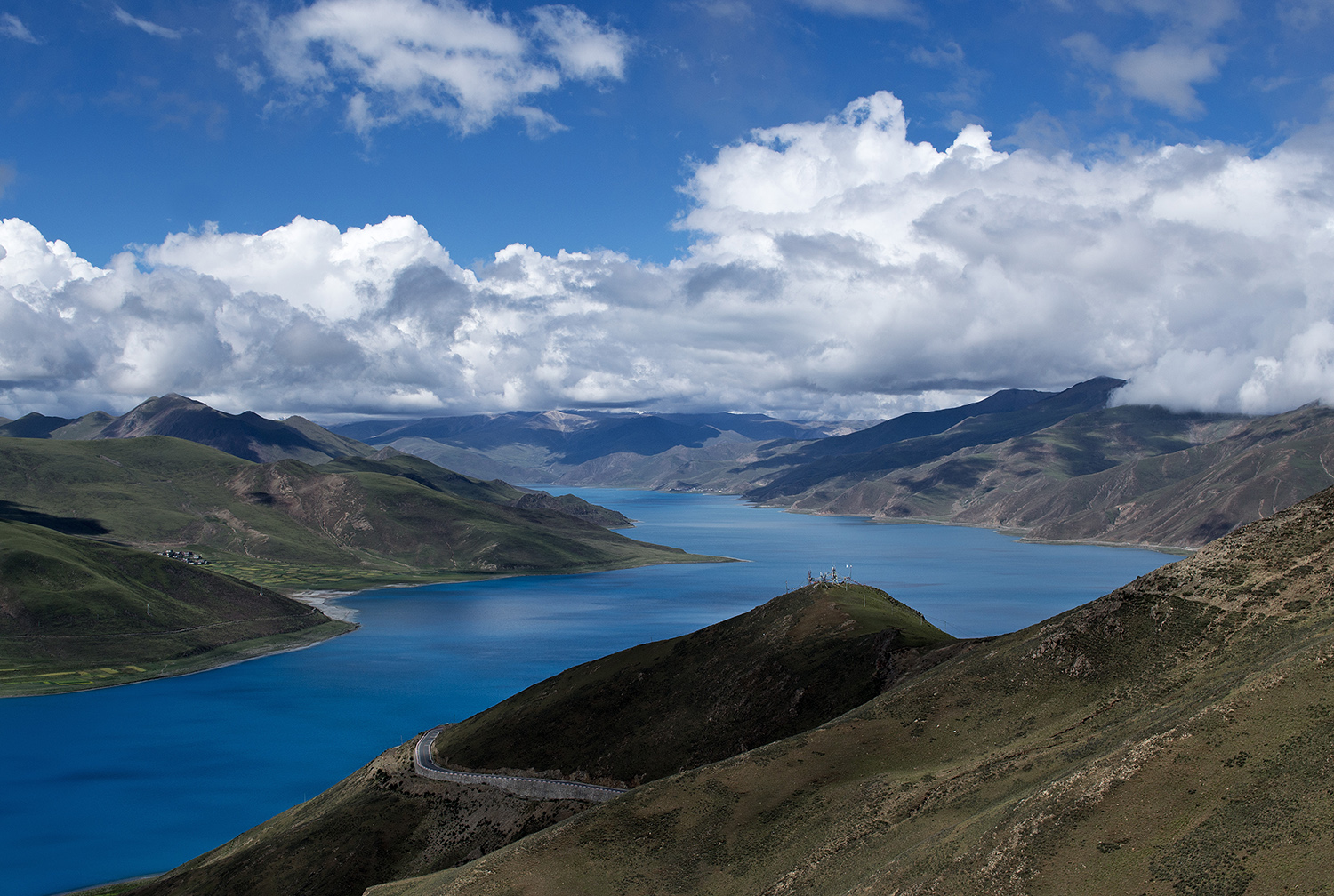
Tibet’s grasslands also lie at the source of many of the great rivers of Asia. Rivers upon which 1.7 billion people in the south, east, and southeast Asia depend.
Healthy grasslands act like a sponge. When the snow melts from the mountains, the water soaks into the soils before it is then slowly released downstream or seeps further underground to replenish groundwater reserves. This means there is a relatively steady flow of water into the rivers. Without the grasses and soils to regulate the flow, the water runs off all at once. Put simply, losing the grasslands has grave implications for water security in China and beyond.
China’s policy towards Tibet now prioritises water provisioning above all else. Anything that gets in the way of water provision from the upper catchment in Tibet is dispensable. The best pasture land in Tibet is between the pristine (but melting) glaciers in the highest mountains, from where the rivers originate, and the lowlands where water is needed. Both the Yellow and Yangtze traverse the pastures of the high plateau. If the many Tibetan tributaries of the Yangtze are included, these rivers flow for thousands of kilometres in Tibet.
Rather than honouring the Tibetan nomads as river keepers and stewards of water purity, or rewarding them with payments from lowland users for upriver guardianship, China sees nomads and their herds as problematic.
China has decided that water is the most important commodity it can obtain from Tibet, including the hydroelectricity extractable from Tibetan rivers. Water is more valuable to China than pastoral production, even though China today eats far more meat, now produced mostly in factory farms. China imports raw materials for its factories from all over the world. But cannot import water both because it is too heavy to ship and the quantities required are so vast. The solution is upriver Tibet, “China’s Number One Water Tower”, a popular official slogan, and the three major rivers – the Yangtze, Yellow and Mekong.
Does delivery of water from Tibet to lowland China necessitate the removal of pastoral nomads, who believe that the rivers, wetlands and lakes of Tibet abound in lu, water spirits that must be respected, not offended? That means not polluting water, greedily extracting too much, not draining wetlands or damming rivers. The widespread belief among Tibetans is that lu are particularly sensitive to pollution and developments through which man violates the environment. The lu are reputed to seek vengeance when they are disturbed, notably by giving the guilty parties illnesses or by altering the balance of the local water table, which results in rivers drying up or abnormally heavy rain. These are powerful and effective constraints on bad behaviour.
In northern China, the shortage of water for industrial, agricultural and urban use is so acute that Tibet seems the only solution. China’s rigid zoning system classifies all land as either economic or ecological, and the rivers, once they leave the high plateau are classified as economic, even when they flow through UNESCO World Heritage protected areas, thus making them available for hydro damming. Further upriver, where the Yangtze, Yellow and Mekong water a vast pasture land, they are classified as solely ecological, which means that all human use, including traditional livestock herding, is defined as a threat, usually requiring exclusion.
In contemporary environmental governance, provision of water for the use of distant downstream users is recognised as an important environmental service. Downstream consumers may pay the upstream conservers (through schemes known as payment for ecosystem services – PES) to compensate the upper riparian communities for incurring the opportunity cost of not developing.
Do China’s lowland factories and cities compensate Tibetans for foregoing development? The only payments by the state are conditional on vacating the land and living in high-density concrete settlements on urban fringes, thus qualifying for transfer payments, usually in kind rather than cash, in bags of rice and flour, vulnerable to corrupt skimming as they pass through many hands before reaching formerly self-sufficient nomads now reduced to dependence.
Anthropologist Xenia de Heering retells a conversation with Drolma Tso, a nomad woman:
“Of course locals are afraid to dig near a spring, they are afraid because according to the Tibetan perspective, there are, like, water deities there. If we dig around there, maybe it will bring disasters, like illness, and even kill people. So I hired some Chinese people to dig near the spring. But it rained a lot, and then local people started to say, It rained a lot because we dug there!… I’ve always believed there are water deities… So I asked all the monks to go near the spring and chant prayers.”Downstream China wants its water from Tibet, not in the summer monsoon season when the problem is too much rain and the danger of flooding. The water is wanted in the other seasons, a primary argument used by the dam and power grid construction corporations for building more dams across Tibetan rivers. However, the best seasonal regulator of year-round water availability is intact glaciers at the river sources and intact forest cover on the steep slopes above the rivers as they start to plunge from the high plateau. Climate change has accelerated glacier melt, providing downriver China with a dividend of increased runoff that may persist, on current trends, until the glaciers have melted by the middle of this century. The Tibetan forests and wetlands that soak up the heavy summer rains were intensively logged and drained by China, over several decades, from the 1960s to the end of the 20th century, and little has been done to restore them. Chinese scientists in Tibet say: “Forested vegetation types were best able to regulate surface runoff. Land use changes have dramatically affected water conservation in the study area in the past several decades; if forested land cover existed at the levels present in 1986 or 1974, the ability of the watershed to intercept surface runoff would increase by about seven percent and three percent, respectively, over its capacity in 2000.” It is surface runoff that causes erosion, degradation and floods. As discussed in the previous section, the degradation of the grasslands – and consequent implications for water security – are best explained by a series of policy mistakes by the Chinese government. In particular forcing nomads to fence their herds, constraining the mobility that had enabled animals to tread only lightly across a vast range, and instead concentrating their grazing in smaller areas, which then gradually degraded. The mandatory enclosure of each family’s herd drastically reduced the mobility, which has always been the secret of sustainable pasture management.
Climate change: Does it makes nomads redundant?
© Kunchok Gyaltsen
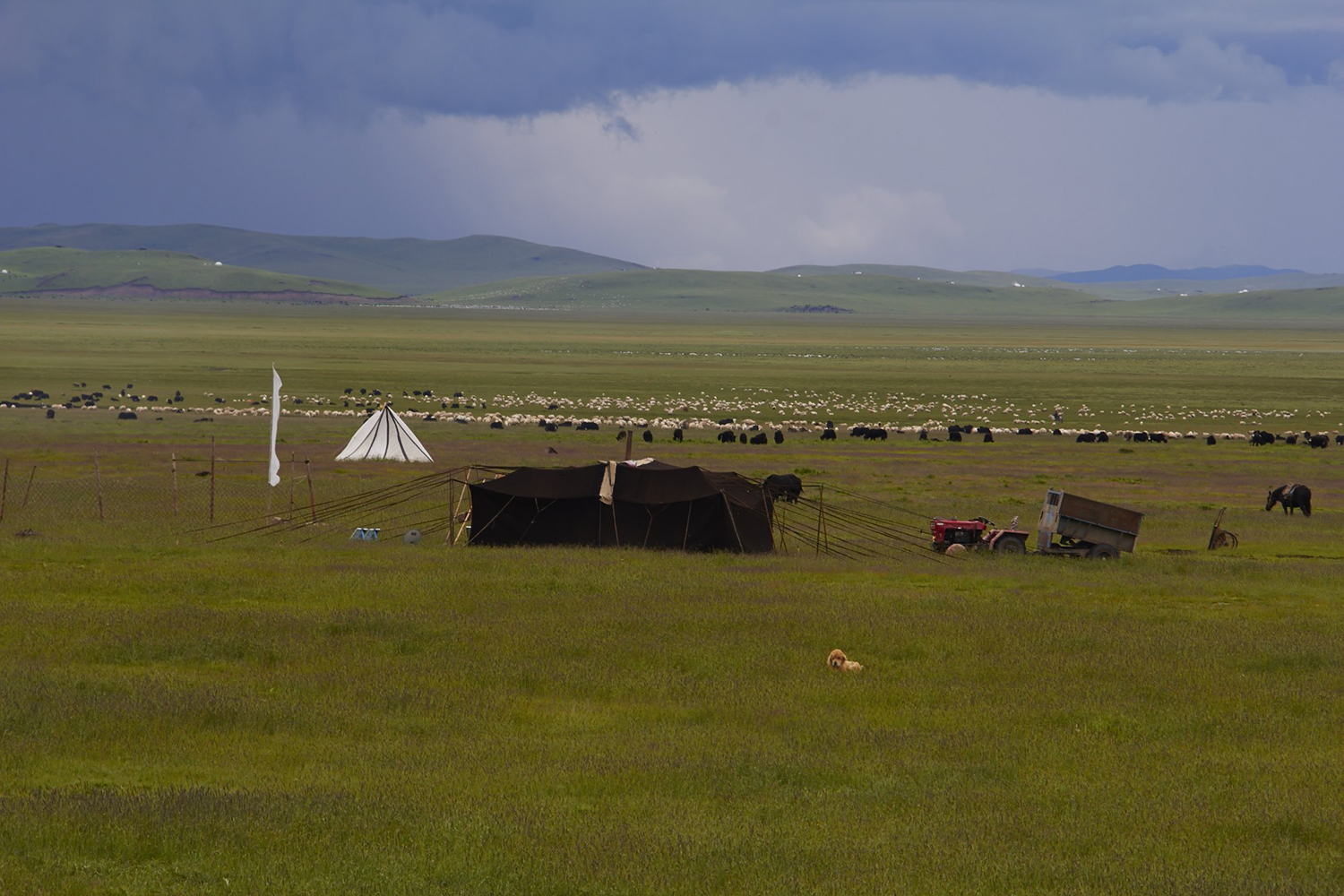
While the biggest of the world’s emitters of greenhouse gases argue endlessly over who has greater responsibility, many other peoples are caught in the crossfire. It is the great misfortune of the Tibetans to have been incorporated into the biggest emitter of all, which, on historical grounds, argues against accepting equal responsibility to reduce emissions. China has given only an unquantified pledge to reduce emissions, starting in 2030. China’s Nationally Determined Contribution (NDC) to the 2015 Paris Agreement, if followed by other countries, is a promise to lift climate warming by century’s end by a disastrous 5.1°C.
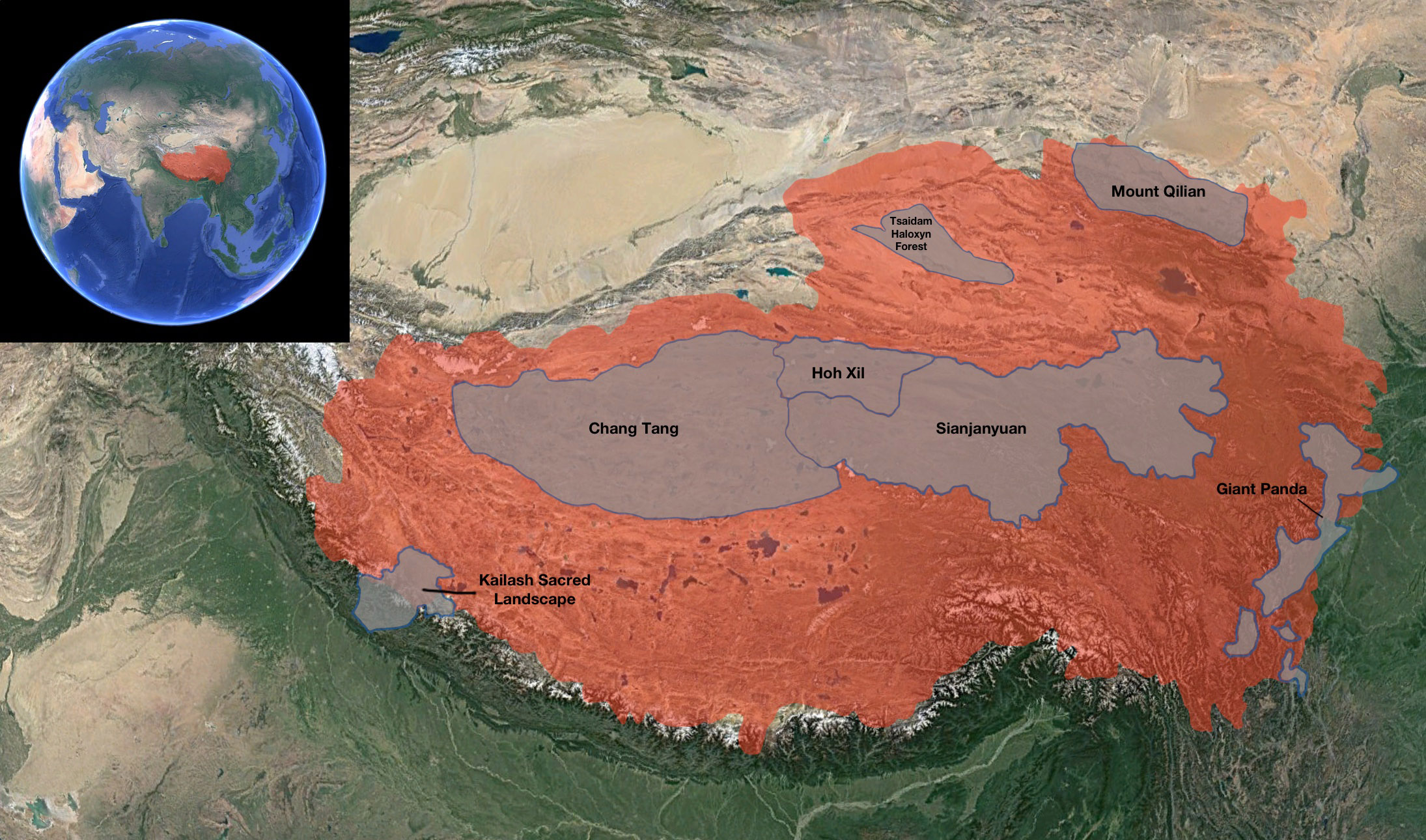
Under pressure to lift its game, China turns to Tibet to improve its credentials for the capture of carbon, offsetting ongoing emissions. The new national parks, covering nearly 30 percent of the entire Tibetan Plateau (see table and map in the Biodiversity section), are designated protected areas whose exclusive functions are to protect China’s water supply, grow more grass, and conserve biodiversity. These worthy goals need not exclude ongoing herd grazing under the skillful stewardship of the traditional land managers, the nomads of Tibet; yet China has designed the parks to largely exclude the nomads from their lands.
Like forests and mangroves, grasslands store vast quantities of carbon in their soils. When they are degraded or die, this carbon is released into the atmosphere, adding to the carbon pollution from the burning of fossil fuels and pushing the world further towards climate catastrophe. In a vicious cycle, more warming means more degradation of grasslands and other ecosystems, which leads to more soil carbon being released, which in turn fuels more warming.
A key question for all who seek to avoid a future of far greater climate disruption is whether the clearance of traditional owners from their pastures across Tibet is necessary, or indeed counterproductive. Does the implementation of China’s official slogan “Close pastures to grow more grass” sequester a significant amount of carbon from the atmosphere into the soil? If the nomads of Tibet surrender their land tenure security, becoming “ecological migrants”, does their sacrifice, whether voluntary or not, make a real difference to global atmospheric carbon levels? Is Tibet a net emitter or storer of carbon, with or without the nomads’ herds of yak, sheep and goats?
These are not just questions for China since it has put its redline maps of national parks in Tibet into the global debate on who is doing what, as part of the global carbon market. After grazing bans are enforced, grass does indeed grow to greater biomass. There is abundant scientific measurement of that. For a few years, at most, biomass increases in the absence of ungulate teeth. Then what?
Under the official policy of tuimu huancao (Close pastures to grow more grass), in effect since 2003, there is now scientific evidence of the longer term consequences of reducing the best pasture lands to a single metric biomass. Unlike a forest, there is a limit to how much carbon grasses can sequester, and for how long.
Ungrazed depopulated grassland in Tibet loses biodiversity, as longer grasses outcompete the low herbs required for traditional Tibetan human and veterinary medicines. Loss of biodiversity leaves hardy grasses and sedges dominant, often succeeded by shrubs, but not trees. Grassland fire risk grows. If carbon sequestration is to be meaningful, captured carbon must stay reliably in the soil for decades, and carbon offset contracts specify this.
The reality on the ground in Tibet is more complicated. Not only is the climate more extreme, across a vast island far up into the troposphere, it is also highly variable. While China calls Tibet its’ ‘number one water tower’, the reality is that the Tibetan Plateau is arid compared to the lowlands, its glaciers are rapidly losing mass, and seasonal permafrost now melts earlier and faster, releasing methane into the atmosphere. Depth of permafrost has decreased by 6.5 cms each decade, and permafrost melt each year now happens between 3.2 and 7.6 days earlier. The resulting methane emissions are disastrous, not only for Tibet but for the planet.
China’s dividend of increased river flows due to glacier melt will turn to deficit when the glaciers are gone. That will take most of this century far away enough for little immediate concern; and perhaps compensated for by increasing precipitation. For thousands of years, lake levels across Tibet have been slowly falling, as monsoon rains reaching into Tibet from the Bay of Bengal through the Himalayas lost some intensity. That has now reversed especially in the land of lakes of northern Tibet. The summer of 2018 was one of the wettest known in Tibet, and Chinese scientists now worry about lakes breaking their banks and flooding far below.
On paper, the removal of livestock should remove methane emissions, even if the populations of wild Tibetan gazelles and antelopes surge, as planned. However, emissions from animals on pasture are much less than China’s intensification of meat production in factory farm feedlots reliant on importing tens of millions of tons of soybeans across the Pacific from growers in the Americas. Growing rice in flooded paddy fields generates at least 15 percent of global methane emissions, but no one suggests that southern China stop growing rice.
As yet, there is no clear evidence as to whether the Tibetan Plateau – close to two percent of the planetary land surface – is a net emitter or capturer of carbon, or whether the clearance of herds and herders from 660,000 sq km of national parks will make much difference.
Under the formulae for equitable Payment for Environmental Services (PES) and Reducing Emissions from Deforestation and Forest Degradation (REDD+), the many Tibetan nomads already demobilised and displaced from their lands should be receiving compensation payments from emitters. It is not the case in Tibet. Although China is establishing a carbon market, its steel mills, aluminium smelters and other polluters do not compensate Tibetan nomads for their loss of land, livelihood, food security and customary role as stewards of sustainability. Nor do they pay excluded nomads for the water Tibet provides those industries by incurring the opportunity cost of foregoing development and closing pastures.
China’s rising emissions come not only from industry but also its past policy mistakes in Tibet, from widespread deforestation in eastern Tibet, also adding to erosion, river sedimentation and flooding, with little attempt at the labour-intensive work of reforestation on steep slopes amid sharp frosts that kill exposed seedlings. Further intensification of emissions comes from widespread draining of Tibetan wetlands, resulting in methane emissions and peatland fires. Some remediation is now occurring. A warming climate reduces alpine wetland photosynthesis and carbon sequestration.
Like the small island states in the Pacific, Tibet and its people are dangerously impacted by global warming it did almost nothing to cause.
Displacing nomads to alleviate poverty?
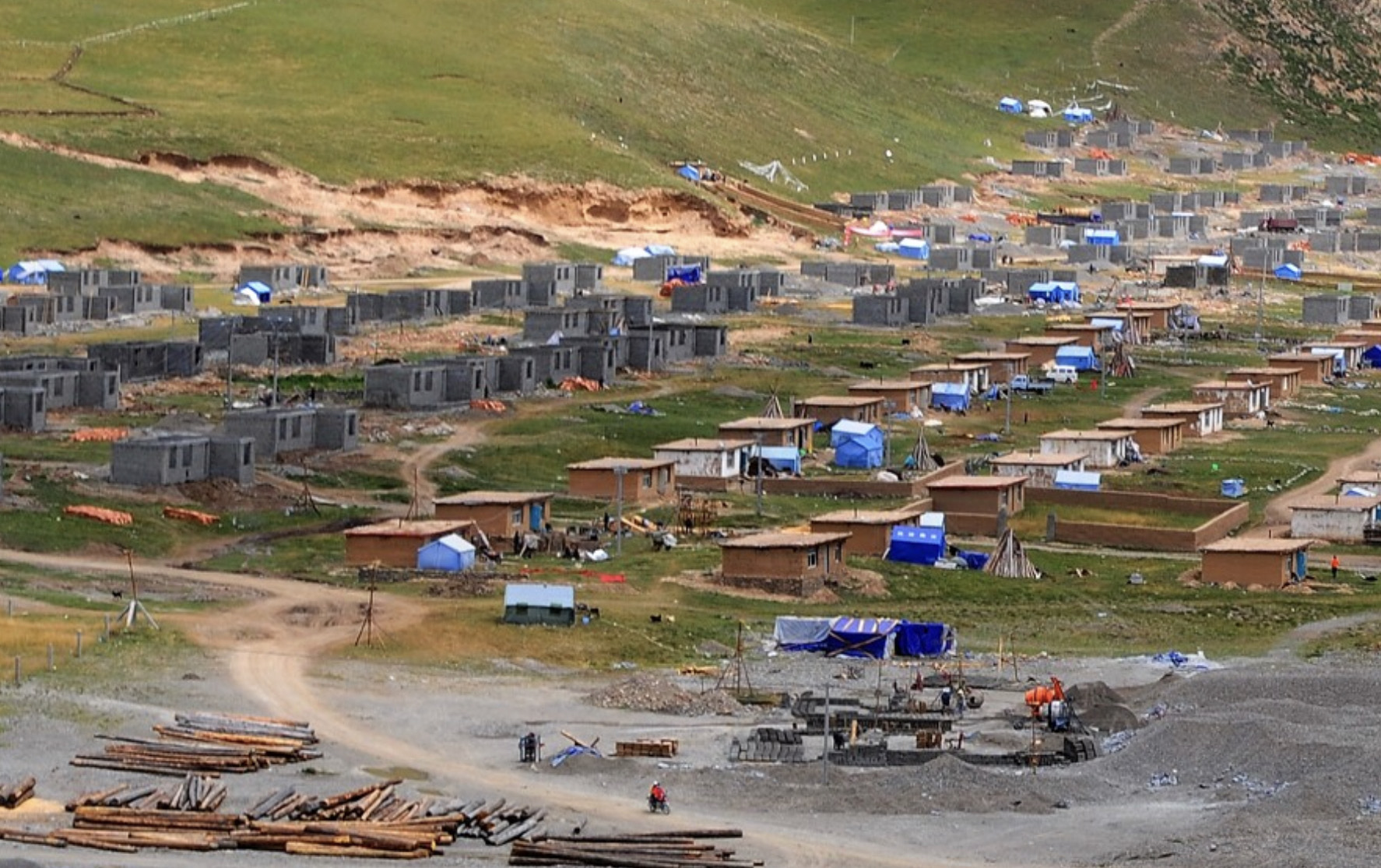
China believes its policy of forced resettlement that began in 2003 under the tuimu huancao slogan is necessary to alleviate poverty among nomadic communities.
Resettlement policies are typically carried out with little consent or consultation with affected communities. They have no means to challenge the policies or to refuse to participate in resettlementprograms. Nomads are typically moved into purpose-built concrete compounds, often far from employment opportunities and essential services. Language barriers, prejudice and other disadvantages often make it hard for the newly settled Tibetans to enter the increasingly Chinese-dominated workforce.
One detailed case study of resettlement in the Sanjiangyuan area in the centre of the Tibetan Plateau uncovered a heartbreaking catalogue of negative social and economic consequences for the former nomads. Stripped of their traditional livelihoods and presented with few new employment opportunities, interviewees struggled to meet their most basic needs.
“Everything here costs money. A slice of meat costs 10 RMB, so does a bag of livestock dung [for household fuel]. We can’t afford them. When we lived on the grassland, we didn’t need very much at all. We got everything from our livestock.”Tragically, the impact of resettlement goes beyond the loss of livelihoods and security, and can profoundly impact a community’s identity, cohesion and spiritual wellbeing. Unfamiliar surroundings and dislocation from ancestral land can leave individuals and whole communities unmoored, lacking any sense of belonging, and severed from everything that had given life order, grounding and purpose. This may lead to increased alcohol consumption, crime and other social problems. Overall, while resettlement may initially come with promises of better access to healthcare, education and other benefits, accounts consistently show nomadic communities becoming worse off after the relocation. As noted by the Central Tibetan Administration:
“Tibetan nomads, who once lived happy and self-sufficient lives, have been suddenly thrust into dislocation and poverty. Ultimately, this is the state-engineered destruction of a culture and a way of life.”One of China’s core arguments for the forced removal of nomads from their pastures is that it is necessary for their good because they are poor and their poverty is the inevitable outcome of having to live in such a harsh landscape and that the only solution is relocating to the fringes of distant towns. China labels this contiguous poverty, the toughest to eradicate, because it arises due to the absence of all factors that encourage productivity. Officially they are called contiguous destitute areas (个集中连片特困区贫困). Tibetan pastoralists do not see it that way. They consider themselves the gatherers of what nature seasonally provides, with many months each year when there is little work to be done, and plenty of time to undertake long pilgrimages or trading expeditions, honour local gods, weave tents and ropes or teach the young. Far from feeling poor out on the open range, there is a deep nomad tradition of tsethar, freeing animals for life, marking herd animals, so everyone knows they are to peaceably live out their full life on the pasture, with no threat of sale or slaughter. This widespread practice has gained momentum in recent years, despite China’s pressure on nomads to behave more like industrial commodity agribusinesses, sending animals for slaughter much faster and younger. Tibetan nomads know Chinese and other outsiders see their life as hard, close to bare subsistence and even aimless since they wander with their animals. The nomads consider such views absurd, since livestock management and production, while also curating entire landscapes, protecting wildlife and maintaining plant biodiversity are skilled work, all based on a willingness to maintain mobility. Nomads often talk of wealth, not poverty. In Tibetan, wealth is nor, and the best of all nor is a herd on the hoof, on an alpine meadow, fattening on the abundance nature seasonally provides. So when nomads are vexed by demands, they reduce herd size, sell stock younger and more often, downsize or altogether end what they learned from earlier generations, to keep whole landscapes healthy and productive, by mobile, moderate grazing. China’s view distresses nomads, and also Tibetan officials in local government:
“Overall, pastoralists in our county regard the rangeland contracting policy as a demon and reject it. First, people do not accept the idea of dividing all the land – they are concerned about livestock grazing and disputes over the land after it is divided. But it is a very bad idea to divide all the land. Also, dividing the land makes it very difficult to graze livestock as it will redistrict livestock mobility. It will keep livestock well fed and happy if they can move around to graze.”In recent years, science has caught up, discovering that moderate grazing results in the greatest grassland biodiversity. Heavy grazing endangers plants, which the nomads have always known. Removing grazing results in an immediate flush of biomass, but reduced biodiversity as long grasses crowd out delicate herbs essential to traditional Tibetan human and veterinary medicine manufacture. If grazing is removed for a few years, there is no further accumulation of biomass and carbon, but grassland becomes shrubland, which is no longer productive. Chinese scientists and policymakers, however, have spent decades operating on the simple assumption that all grazing is degradation of plant biomass. Officially, this is expressed as a Marxist dialectic: “There is a contradiction between grass and animals.” The solution to this contradiction is that herds and herders should be removed. Since China never invested in adding value to nomad production such as wool, dairy and animal products, incomes in rural Tibet now lag far behind incomes in the heavily subsidised towns and cities of Tibet where Chinese settlers live, where there is plenty of state employment for security personnel. China’s massive investment in infrastructure across Tibet is largely confined to the mines, dams, power grids, urban centres and network of highways and railways connecting these nodal enclaves. Rural Tibet remains without effective linkages to lowland China, even though urban China has a big appetite for yoghurt and other dairy products. Inequality is now extreme in Tibet and throughout China. So rural Tibetans are now relatively poor; a matter of distributive justice. That does not mean they want to leave their land or see moving to urban fringe settlements as the solution. Even after they are resettled, and their land tenure security cancelled, they still consider themselves to be nomads, and often manage to outsource their herds to those who remain on the land. Urbanisation is now China’s solution to everything, but nomads, who seldom speak Chinese and even less often read or write it, are effectively shut out of urban labour markets except for casual, unskilled work in road making and construction labouring. On paper, China argues that these displaced nomads are wealthier because of transfer payments from the central government. In return, those removed are required to show gratitude at the benevolence of central authorities in raising not only cash income but also their level of “civilisation”. According to official statistics, transfer payments in rural Tibet have reached RMB 2167 per person per year, around US$310. For nomads displaced to urban fringes, those transfer payments are usually bags of rice and subsistence rations, of low quality, poor substitutes for formerly proud, independent food producers.
Biodiversity: Creating wilderness
© Nigel Hungerford
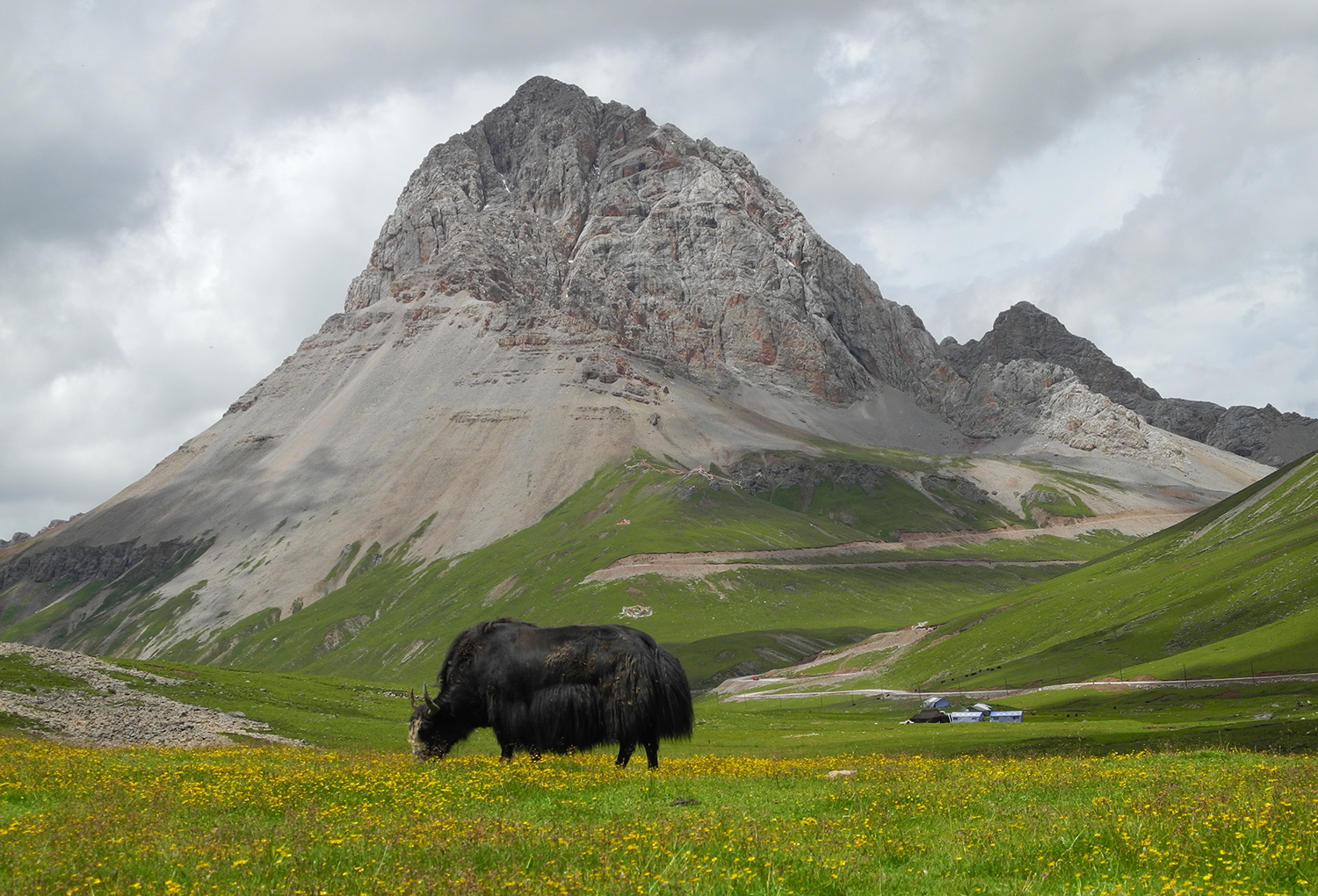
China’s clincher for many new national parks that largely exclude nomads from their pastures is biodiversity, and the official goal of creating a pristine, unpeopled wilderness that will attract mass domestic tourism.
China has recently discovered the biodiversity of the Tibetan Plateau and the need for conservation of endangered species. For decades, the remote pastures and mountains of Tibet were a wild west, where illegal miners and wildlife poachers roamed with impunity, held accountable only by Tibetan patrols willing to confront the well-armed hunters.
Now the state has taken over, disbanding the famous Tibetan Wild Yak Brigade of wildlife protection rangers. Drawing red lines on maps, declaring large territories to be national parks, is now the official method of protecting wildlife, with many exclusion zones in which all human activity (other than scientific research) is banned.
Bottom-up community-based approaches have been ignored. This worries the specialists in Chinese studies:
“The top-down approach is prioritised in the planning and management of the national park system, and the involvement of civil society groups in the making of China’s national parks does not guarantee an inclusive and bottom-up approach. From the 1970s onwards, worldwide the conservation paradigm gradually shifted to recognise the importance of a participatory and inclusive approach to protected area management. China’s moving away from such understanding and practice may eventually undermine the rights of local communities and threaten to hamper the conservation goals that the national parks aim to achieve.”“Top-down” is not a term applied only by outsiders to describe the design, operations and management of China’s new national parks. It is also how China’s central planners see it themselves. The official phrase 自上而下, zi shang er xia means top-down, designed by top-level computerised systems theory. From the 1980s to 2000s, many of the world’s leading conservation NGOs were active in Tibet. Some formed close partnerships with Tibetans keen to conserve wildlife and habitats, at a time China ignored its lawless wild west, allowing rapacious slaughter and extraction to persist. Some of those NGOs still quietly work on the ground to mitigate the imposition of top-down models. One of the earliest to understand the importance of Tibetan wildlife was Conservation International (CI), which set up a Critical Ecosystem Partnership Fund, a joint initiative of l’Agence Française de Développement, Conservation International, the Global Environment Facility, the Japanese government, the MacArthur Foundation and the World Bank. CI’s program The Mountains of Southwest China identified the location of the Tibetan biodiversity hotspot – not where most of the new national parks are but in Kham, including parts of western Sichuan, northwest Yunnan, eastern parts of Tibet Autonomous Region, the southeast tip of Qinghai and the southern tip of Gansu. This huge hotspot is home to about 50 percent of the country’s birds and mammals and more than 30 percent of its higher plants. However, only a fragment of this massive hotspot will be protected under the new national parks to be unveiled next year. China has instead turned to the three rivers source, the Sanjiangyuan, to the north, which is far less biodiverse, but the source of China’s biggest rivers, essential to water provisioning for lowland China. In China’s domestic tourism market, and with animal lovers worldwide, protection of iconic wild species is a winner. There is an immediate, wholehearted connection to photos of headline endangered species such as snow leopards, pandas, wild yaks, gazelles and antelope. Is this newfound concern to protect wilderness what drives China’s new system of national parks? Does biodiversity conservation necessitate excluding most nomads from lands they have always curated and cared for? China will no doubt receive significant international praise when it launches its new system of national parks. Powerful actors will be willing to overlook the darker side of this program and herald another sign of environmental leadership from China, at a time when the world is grappling with the twin challenges of climate breakdown and biodiversity loss. This unfortunate reality heightens the need to better understand the motivations and mistakes behind China’s ongoing moves, the consequences for Tibetans and Tibet’s environment and to advocate for a better path forward. Tibet and China are already teeming with various types of protected areas, managed variously at the national or provincial level, including nature reserves, UNESCO World Heritage properties, and Ramsar protected wetlands. China’s new national parks system will see some existing protected areas upgraded to National Park status, while others will have their boundaries redrawn and modern management practices put in place to bring them to the new standard. Management of the parks, along with other types of protected areas, is now centralised under a new National Forestry and Grassland Administration, and the different types of protected area consolidated into fewer categories. Design of the Sanjiangyuan and Qilian/Dola Ri parks has been facilitated by a major multi-year project of the UN Development Programme, financed by the World Bank’s Global Environment Facility. Most significantly for Tibetans, China’s plan requires nearly all human activities except science and tourism to cease within these new national parks.